Knee Replacement Weight Limit: How BMI Shapes Surgery Eligibility in the UK

✅ Medically reviewed | Updated september 2026
Knee replacement weight limit rules leave many UK patients confused. A patient’s weight can decide whether surgery goes ahead. Limits differ between NHS areas, hospitals and private clinics. Some patients wait months for a decision. Others receive a flat refusal. Clear facts help patients plan the next step. Some prefer a non-surgical route, so Arthrosamid injection London appointments often begin with the same BMI discussion. Price also matters, and many patients search for Arthrosamid injection cost UK before booking.
Is There a Weight Limit for Knee Surgery?
Yes, but the limit is a guideline rather than a law. Each hospital or health board sets its own knee replacement weight limit. Most services measure body mass index instead of raw weight. Some local policies add a waist measurement as a second check.
BMI has flaws. Muscular athletes can score high without carrying excess fat. It also ignores where the body stores fat. Even so, most services still rely on it because it links well with surgical risk.
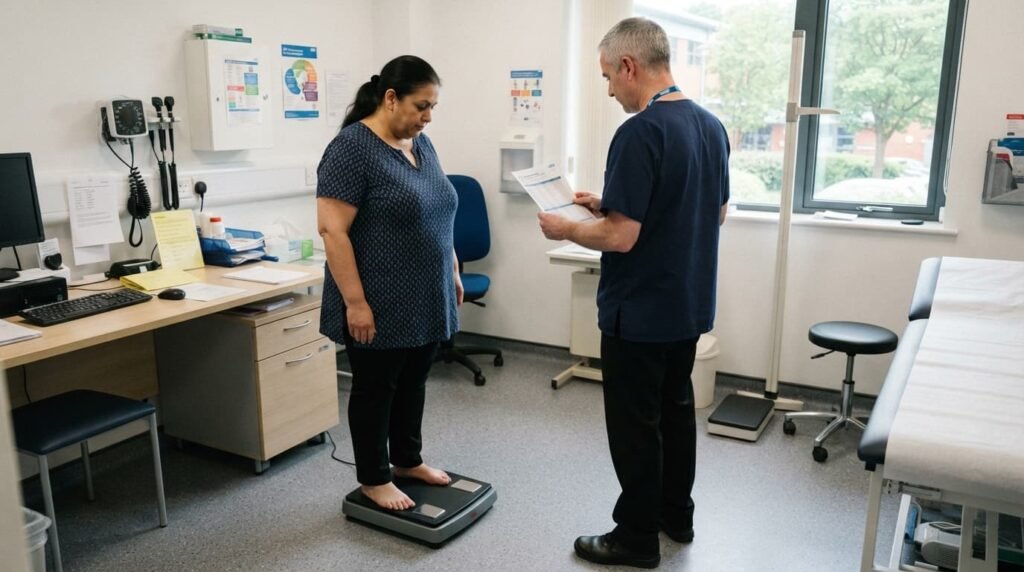
How BMI Is Calculated
BMI divides weight in kilograms by height in metres squared. Two worked examples show the effect. A person weighing 100 kg at 1.75 m has a BMI of about 32.7. A person weighing 85 kg at 1.70 m has a BMI of about 29.4. Height changes the sum, so two people of equal weight can score very differently. The NHS offers an online calculator that does the maths in seconds.
Healthy BMI Range UK
The NHS defines the healthy BMI range UK adults should aim for as 18.5 to 24.9. Scores from 25 to 29.9 count as overweight. Scores from 30 to 39.9 count as obese. A score of 40 or above counts as severely obese. Surgical risk rises at each step.
Why Surgeons Set BMI Cut-Offs
Cut-offs exist to manage risk. A higher BMI raises the chance of wound problems, infection and heart or lung complications. It also adds load to the new joint. Anaesthetic teams find airway and breathing management harder at higher weights.
Surgeons weigh those risks against the benefit of pain relief. At some point, the risk outweighs the gain. Teams use BMI for knee surgery as a shared starting line, not a final verdict. Surgeons have also invented many polite phrases to avoid saying “weight”. None of them fools anyone.
Knee Replacement BMI Limit: NHS, CCG and Private Thresholds
Thresholds vary widely across the country. Three settings matter most.
Knee Replacement BMI NHS Thresholds
Knee replacement BMI NHS policies often set a cut-off between 30 and 35. One NHS clinic in Evesham applies 35. Some regions lower the line to 30. Patients above the line usually receive weight management advice and a review date.
Knee Replacement CCG BMI Policies
Clinical commissioning groups once wrote these rules. Integrated care boards replaced them in England in 2022. Many older policy documents still carry the knee replacement CCG BMI wording.
Neighbouring areas can give different answers. Postcode still influences access more than most patients expect. Scotland, Wales and Northern Ireland run separate health systems, so their rules differ again.
Private Hospital BMI Limit for Knee Replacement
Private hospitals often allow a higher score. One knee surgeon Cheltenham patients consult sets the private cut-off at 40. The BMI limit for knee replacement in private care therefore tends to sit above NHS levels.
Anaesthetic teams also review general fitness. A hospital limit is rarely the only hurdle.
Overweight Knee Replacement: What BMI 30, 35 and 40 Mean

Three numbers dominate these conversations. Each carries a different practical message.
BMI 30 Knee Replacement
A BMI of 30 marks the start of obesity. Some strict local policies still ask patients to fall below it. BMI 30 knee replacement rules apply only in some areas.
Modest weight loss can shift a borderline score. A patient weighing 100 kg at 1.75 m has a BMI of 32.7. Losing 10 kg brings it down to about 29.4. That 10 per cent loss also reduces knee symptoms.
BMI 35 Knee Replacement
BMI 35 knee replacement thresholds appear in many NHS policies. Surgeons often welcome clear progress, even when the target has not yet been reached. Documented weight loss also helps later discussions about eligibility.
BMI 40 Knee Replacement and High BMI Knee Replacement
BMI 40 knee replacement cut-offs are common in private care. A knee replacement BMI over 40 needs individual assessment. In practice, the knee replacement weight limit is rarely absolute at this level. Research on high BMI knee replacement supports a case-by-case view.
One five-year study followed partial knee resurfacing patients with a BMI over 40. They reported excellent implant satisfaction and outcomes. A high number does not always mean a closed door. Surgeons still encourage weight loss after the operation.
How Does Weight Affect Knees?
Every step loads the knee with several times body weight. Each extra pound adds roughly four pounds of pressure during walking. Cartilage wears faster under that load.
Adults with a BMI above 30 are about four times more likely to develop knee osteoarthritis. Carrying extra weight makes the knee work harder with every single step. The reverse also holds. Losing ten pounds removes about forty pounds of load.
Extra weight can also change gait, which adds stress to other parts of the joint. One study found that symptoms worsened step by step as BMI groups rose.
Osteoarthritis Knee Causes Beyond Weight
Weight is one cause among several. Age, old injuries, genetics, joint alignment, sports history and heavy manual work all contribute. Body fat also releases inflammatory chemicals that affect joints.
Slim people still develop arthritis. Blame helps nobody. Understanding the mechanics helps everyone.
Knee Replacement Risks and Revision Rate at a Higher BMI

Knee Replacement Risks
Common risks include infection, blood clots, stiffness and slow wound healing. A higher BMI raises several of these. Anaesthetic risk also increases.
Careful recovery matters as much as the operation itself. Small errors in the first weeks can slow progress. Wound care, physiotherapy and early walking all shape the final result.
Knee Replacement Revision Rate
The knee replacement revision rate rises slightly with a higher BMI. The absolute number remains small. Older patients tend to be less active, so implant wear matters less for them.
Younger patients face a longer horizon. Implants last longer when BMI stays lower. Surgeons therefore push weight loss harder in younger adults.
Other Factors Surgeons Check Besides BMI
BMI is one measure among many. Surgeons build a wider picture of fitness before agreeing to an operation.
General Health and Lifestyle
Teams commonly review smoking, blood sugar control, blood pressure, heart and lung health and anaemia. Smoking slows wound healing. Poorly controlled diabetes raises infection risk. Dental and skin infections need treatment beforehand because bacteria can reach a new joint.
Stronger thigh muscles also speed recovery. A fitter body before surgery usually means a smoother recovery afterwards.
What Happens at a Surgical Assessment
The visit usually includes a medical history, a knee examination and X-rays. Staff record height and weight and calculate BMI. The surgeon then discusses risks, benefits and alternatives.
Patients can ask about the local BMI policy and any route to individual review. A list of previous treatments, medicines and injections saves time.
Arthritis UK, NICE Guidelines and the NHS Rationing Debate
Arthritis UK BMI Surgery Position
Its briefing states that almost a fifth of integrated care boards ignore NICE guidelines knee replacement patients rely on. Those boards ration surgery by BMI without a proper individual assessment.
The charity warns of avoidable suffering, prolonged pain and faster joint deterioration. It also links thresholds to wider health inequalities.
NHS Rationing Knee Surgery BMI: Both Sides
Supporters of limits argue that they protect patients and use funds wisely. Critics argue that delays cause harm. Arthritis pain also makes exercise hard, which traps patients in a cycle.
One Yorkshire consultant calls refusal cruel for older patients who have tried and failed to lose weight. Critics also argue that a rigid knee replacement weight limit ignores individual health.
Can Weight Prevent Knee Replacement?
Sometimes, yes. A BMI above local limits can delay or block a referral. Weight loss can also postpone the need for surgery in the first place. Both outcomes make early action worthwhile.
Lose Weight Before Knee Replacement: Practical Routes
Getting under the knee replacement weight limit takes planning. Three routes stand out.
Diet and Movement
Weight loss before knee surgery starts with small, steady changes. A 5 per cent loss improves knee function. A 10 per cent loss reduces osteoarthritis symptoms further.
A daily calorie deficit of about 600 produces roughly 2 lb of weekly loss, according to one physiotherapy guide. A GP or dietitian can set a safe plan.
Diet and exercise work best together. One study found that neither alone improved knee pain significantly, but the pair did. Swimming, cycling and water exercise protect the joint. Good nutrition supports both weight loss and joint health.
Crash diets promise miracles and deliver hunger. Slow progress wins.
Ozempic Knee Replacement and Weight Loss Drugs Osteoarthritis
Interest in Ozempic knee replacement plans has grown fast. A 2024 trial found that weekly semaglutide cut both weight and knee pain more than placebo. The participants had obesity and knee osteoarthritis.
Research into weight loss drugs osteoarthritis patients might use continues. Surgeons report that more patients now reach a lower BMI. Fast weight loss does not always mean fitness for surgery.
Patients need a stable period after weight loss. Good nutrition supports healing. A GP or specialist decides who qualifies for treatment.
Gastric Band Before Knee Replacement
Some patients cannot exercise because arthritis pain limits movement. Certain surgeons then suggest a gastric band before knee replacement. Others favour weight loss surgery before knee replacement more broadly.
One study found significant knee symptom improvement six and twelve months after bariatric surgery. The step is drastic. It needs specialist discussion and careful timing.
What to Do After a BMI-Based Refusal
A refusal is not always final. Patients above the knee replacement weight limit have several practical options.
- Ask the GP or surgeon for the written local policy and the exact BMI figure used
- Request an individual assessment, since national guidance expects one
- Ask about referral to an NHS weight management service
- Seek a second opinion from another surgeon
- Explore private care, where the limit may differ
- Keep a dated record of weight readings, because progress supports later discussions
Persistence and paperwork often achieve more than frustration.
Partial Knee Replacement and Partial Knee Resurfacing
The knee has three compartments. A partial knee replacement treats only the damaged one. This approach preserves healthy bone and ligaments. Recovery is often quicker because surgeons remove less bone.
Partial knee resurfacing follows a similar principle. Suitability depends on which compartments are damaged and on ligament health. Some studies suggest that BMI does not change implant survival in these procedures. One mid-term study concluded that patients with obesity should not be excluded. Individual surgeons still make the final call.
Knee Replacement Age Limit
No fixed upper age limit exists. Fitness and overall health matter more than the birth date. Older patients in good health can still qualify. Younger patients need extra care because implants wear over decades.
Non-Surgical Options While Weight Comes Down
Non-surgical care can ease pain during weight loss. Options include physiotherapy, pain relief, walking aids and injections. Non-surgical care changes as joint damage advances, so timing matters. Patients above the knee replacement weight limit often need this bridge.
Arthrosamid is one option for suitable patients. The hydrogel sits inside the knee joint and cushions movement. It suits mild to moderate osteoarthritis rather than advanced disease.
Doctors assess suitability case by case. One study excluded patients above BMI 35. Another summary reported better results in people with a healthy body weight. Reported success rates vary between patients.
A clinic comparison of PRP and Arthrosamid quotes typical UK pricing of £2,000 to £4,500 per injection. Repeat PRP courses can match that total over several years.

The clinic’s YouTube channel explains knee osteoarthritis and how Arthrosamid works in short videos. Watching first makes the consultation far more productive.
Frequently Asked Questions
What is the knee replacement weight limit for NHS patients?
There is no single NHS-wide BMI limit. Each hospital may have its own policy, and your overall health and surgical risk are also considered.
Can you have a knee replacement if overweight?
Yes. Being overweight does not automatically prevent knee replacement. However, a higher BMI can increase the risk of complications, so weight loss may be recommended before surgery.
What BMI cutoff do private hospitals use for knee surgery?
Private hospitals have different policies. Some may accept higher BMIs, while others may recommend weight loss first. An individual assessment is needed.
Can losing weight help knee osteoarthritis?
Yes. Losing around 5–10% of body weight can reduce pressure on the knee and may improve pain and mobility. Weight loss does not, however, repair damaged cartilage.
Do weight-loss drugs help osteoarthritis?
Weight-loss medicines such as semaglutide may help reduce body weight and knee pain in some patients. They do not repair cartilage and should only be used under medical supervision.
How much weight should I lose before surgery?
There is no universal target. Your surgeon may recommend a personalised goal, with 5–10% weight loss often providing meaningful benefits.
Does a higher BMI increase complications after knee replacement?
A higher BMI can increase the risk of wound problems and infection. Your individual risk depends on your overall health and should be discussed with your surgical team.
Are there alternatives to knee replacement?
Yes. Depending on your condition, options may include exercise, physiotherapy, weight management and injections such as Arthrosamid hydrogel. KneePainClinicUK provides specialist assessment for suitable patients.
Being overweight does not automatically rule out knee replacement. Losing 5–10% of body weight may help reduce knee pain and improve mobility, while some patients may also benefit from non-surgical treatment options.
Mr Syed Nadeem Abbas (MBBS, MRCSEd, MSc) has over 20 years of experience treating complex knee conditions, with a focus on joint preservation. He provides personalised assessments to determine whether options such as Arthrosamid hydrogel injection, other non-surgical treatments, or knee replacement are appropriate for each patient.