Joint Pain in Overweight Women Ignored Until It Gets Worse

✅ Medically reviewed | Updated July 2026
Joint pain in overweight women is rarely a coincidence. Extra body weight places direct mechanical pressure on the knees, hips and hands, while fat tissue also drives inflammation throughout the body. For many women, this combination shows up earlier and more severely than expected, often well before the typical age linked with osteoarthritis. Hormonal changes around menopause add a further layer, shifting fat storage and accelerating joint strain at a time when cartilage is already losing resilience. Joint pain that overweight women face is therefore rarely caused by one single factor, but by several factors working together. Understanding how these elements interact makes it easier to take practical, evidence-based steps toward relief.
Why Joint Pain in Overweight Women Differs From Men
Women carry fat differently from men, and this matters for joint health. Being overweight and joint pain in women are often connected to both hormonal changes and fat distribution patterns. Oestrogen plays a role in cartilage maintenance, and levels naturally decline during perimenopause and menopause.
This decline coincides with a period when many women also gain weight around the hips and thighs. The result is added strain on weight-bearing joints at a time when cartilage is already more vulnerable. Joint pain overweight women report during this stage often appears suddenly, even when weight gain has been gradual.
Hormonal Shifts and Fat Distribution
Menopause changes more than mood and metabolism. It also shifts fat storage toward the abdomen, which increases the release of inflammatory chemicals. Obesity and arthritis risk tend to climb together during this hormonal transition, particularly for women already managing some extra weight.

Studies referenced by Johns Hopkins researchers found that overweight women carry close to four times the risk of knee osteoarthritis compared with non-obese women. For overweight men, the figure was closer to five times, though the starting point for women is often lower body weight overall, making the relative jump more noticeable.
How Does Weight Affect Knee Joints During Daily Life
Weight and osteoarthritis are connected through simple physics. Each step sends several times the body weight through the knee joint. Carrying an extra ten pounds can add between thirty and sixty pounds of pressure with every stride.
Does being overweight cause knee pain on its own? Not always, but it significantly raises the odds. The knee absorbs this repeated load across cartilage that has no blood supply of its own, relying instead on movement to circulate nutrients.
Mechanical Stress and Cartilage Wear
Excess weight knee cartilage damage develops gradually rather than overnight. Repeated compression beyond what the joint was designed to manage wears down the protective surface over the years. Once that cushioning thins, bone can begin grinding against bone.
This pattern explains why overweight knee pain relief strategies focus heavily on reducing daily mechanical load rather than chasing dramatic transformations.
Inflammation From Fat Tissue
Mechanical stress is only part of the picture. Inflammation from fat and joint pain are closely linked through chemical signals released by fat cells. These proteins travel through the bloodstream and can affect joints that carry no weight at all, including the hands.

Hand osteoarthritis and obesity show this clearly. Women who are overweight develop hand OA at roughly double the rate of leaner women, despite hands not bearing body weight directly.
Obesity Risk Factor Osteoarthritis: What the Numbers Show
Obesity risk factor osteoarthritis research is consistent across decades of population studies. Body weight remains one of the strongest and most changeable predictors of joint deterioration.
Knee pain and BMI follow a clear pattern: as BMI climbs, so does the speed of cartilage breakdown. For every five kilograms gained, osteoarthritis risk rises by roughly thirty-six per cent. A BMI above thirty more than doubles the likelihood of knee OA developing.
Body Weight and Knee Osteoarthritis Over Time
Body weight and knee osteoarthritis links appear earlier than many women expect. A Framingham study found that women overweight in their thirties carried significantly higher osteoarthritis risk decades later, long before symptoms appeared.
This timeline matters. Early, modest changes may carry more long-term value than waiting until pain becomes constant. Joint pain in overweight women often becomes harder to manage as cartilage loss accumulates.
Weight Loss and Knee Pain Relief: Does It Actually Work
Weight loss and knee pain relief have a well-documented relationship. Research consistently shows that even modest reductions in body weight produce measurable improvements in pain and physical function.
Losing weight to reduce knee pain by even ten per cent, and research suggests joint pain, mobility and quality of life can all improve. Greater weight loss tends to bring greater benefit, though the relationship is not perfectly linear.

How Much Weight Loss Helps Knee Pain
How much weight loss helps knee pain is a fair question. For every pound lost, the knee carries roughly four fewer pounds of force during walking. Losing ten pounds removes around forty pounds of cumulative pressure with each step.
A meta-analysis of randomised trials found that losing around five per cent of body weight, at a steady pace, produced clinically meaningful pain improvement. This is achievable for most women without extreme dieting.
Weight Loss Knee Osteoarthritis Improvement Is Not Reversal
Weight loss for knee osteoarthritis improvement does not mean cartilage regrows. Once cartilage is lost, it cannot rebuild itself. What weight loss can do is slow further deterioration, reduce daily pain and delay the need for more invasive treatment.
This distinction matters for setting realistic expectations. Progress is measured in reduced strain, not full repair.
Practical Steps That Support Joint Health
Sustainable change rarely comes from extreme measures. Small, consistent habits tend to produce better long-term results for women managing overweight knee osteoarthritis.
- Low-impact movement: Swimming, cycling and flat-surface walking reduce joint stress while building strength.
- Anti-inflammatory eating: Oily fish, vegetables and olive oil support both weight management and reduced inflammation.
- Muscle strengthening: Stronger thigh and hip muscles share the load, easing pressure through the knee.
- Support tools: Cushioned footwear and knee braces can reduce daily strain during the process of losing weight.
- Choose surfaces carefully: Running or jogging on concrete and other hard surfaces increases impact through the knee; stationary cycling and brisk walking on softer ground are gentler alternatives.
- Professional guidance: A physiotherapist can build a programme suited to current pain levels and mobility.
For a deeper breakdown of exercises and dietary changes, the clinic’s article on BMI and osteoarthritis covers practical weight management strategies in more depth. A short explainer video on managing knee pain is also available on the Dr SNA Clinic YouTube channel.
When Lifestyle Changes Are Not Enough
Some women follow every recommended step and still experience persistent pain. This does not mean the effort failed. It often means the joint requires additional support beyond diet and exercise alone.
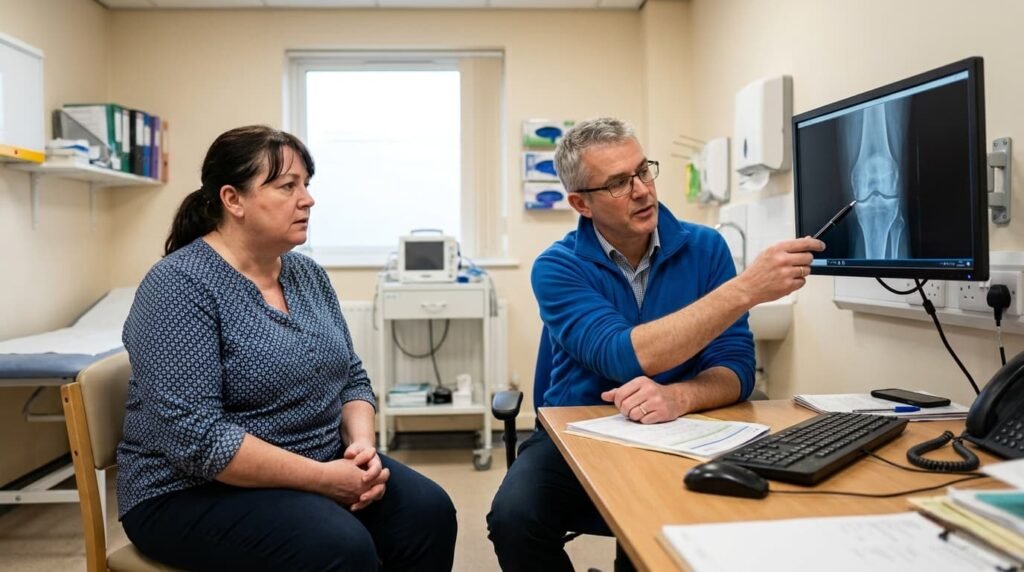
Several signs suggest lifestyle measures alone may no longer be sufficient. These include stiffness that lasts beyond thirty minutes each morning, swelling that does not settle between activities, pain that disrupts sleep, and a noticeable reduction in walking distance over recent months. When these patterns persist despite consistent weight management, a clinical review becomes the sensible next step.
A specialist assessment typically involves imaging to confirm the extent of cartilage loss, alongside a discussion of how symptoms affect daily function. From there, several treatment pathways may be considered, ranging from targeted physiotherapy and pain management to injection-based options for confirmed osteoarthritis.
Arthrosamid injection in London may be considered when knee osteoarthritis symptoms continue despite conservative care. It is described as a long-lasting, non-surgical option for selected patients with confirmed knee osteoarthritis. The treatment involves a hydrogel that remains within the joint and is intended to ease symptoms without the recovery time associated with surgery, making it a relevant option for women keen to stay active during weight management.
Treatment of this kind works alongside continued lifestyle change rather than replacing it. Women who combine injection-based care with ongoing low-impact exercise and weight management often report the most consistent improvement in function and comfort.
Frequently Asked Questions
Does being overweight cause knee pain in every case?
Not always. Being overweight significantly increases the likelihood, since extra load accelerates cartilage wear with every step. Other factors, such as injury history, genetics, and activity levels, also contribute. A clinician can usually identify which factors apply in a specific case.
How does weight affect knee joints differently in women?
Hormonal changes, particularly around menopause, combine with fat distribution patterns to increase joint stress and inflammation in women more than in men of similar weight. Reduced oestrogen also directly affects cartilage maintenance. This makes the menopausal years a particularly important window for joint care.
How much weight loss helps knee pain noticeably?
Research suggests that around five to ten per cent of body weight loss produces measurable pain reduction for most people with knee osteoarthritis. Losing just ten pounds can remove roughly forty pounds of pressure from the knee with every step. Gains tend to build gradually rather than appearing overnight.
Can weight loss improve the symptoms of knee osteoarthritis and reverse existing damage?
No. Weight loss slows further deterioration and reduces pain, but it cannot regrow lost cartilage. It works best as a way to protect remaining joint tissue rather than restore what has already worn away. Combined with strengthening exercise, the benefit tends to be greater still.
Is obesity a risk factor for osteoarthritis relevant for non-weight-bearing joints too?
Yes. Hand osteoarthritis and obesity research shows that fat tissue drives inflammation that affects joints regardless of weight-bearing status. This explains why some women develop joint pain in the hands despite no direct mechanical load there. The link points to a systemic, not purely mechanical, cause.
When should joint pain in overweight women prompt a clinical review?
Persistent stiffness, swelling, or pain that limits daily activity despite lifestyle changes warrants medical assessment. This is especially true if symptoms are affecting sleep, walking or work. Treatment options, including Arthrosamid, can then be discussed where appropriate.
Joint pain that overweight women experience develops through a combination of mechanical load, hormonal change and chemical inflammation, rather than weight alone. Recognising each of these factors early makes management more realistic and less overwhelming. Modest, steady weight loss, paired with low-impact movement and anti-inflammatory eating, has consistently been shown to reduce pain and slow disease progression. For women whose symptoms persist despite these efforts, a clinical review can identify whether additional support, including non-surgical treatment such as Arthrosamid, would help protect long-term joint function. Acting on early signs, rather than waiting for pain to become severe, tends to produce the best outcomes.
Read more: Knee Arthritis Exercises to Avoid That Increase Knee Pain
Read more: New non-surgical knee pain treatments in the UK 2026 with Arthrosamid injection