
Not every exercise supports joint health. Some movements increase pressure inside the knee joint, especially when the joint is already affected by arthritis. When cartilage becomes irritated or worn down, certain exercises may increase inflammation instead of improving strength. This is why many doctors and physiotherapists explain the importance of understanding which activities may aggravate symptoms.
In some cases, treatment planning may also include options such as Arthrosamid injection, especially when pain continues despite exercise changes, guided rehabilitation, and review of arthosamide injection cost uk.
Many people try to stay active, which is positive, but without understanding joint mechanics they may unknowingly perform movements that overload the knee joint. That is often the real reason knee arthritis exercises to avoid becoming such an important part of treatment advice.
Patients also often ask about Arthrosamid injection cost for knee pain, which can vary depending on the doctor’s experience and the clinic.
Three factors often worsen arthritis symptoms including joint compression, repeated impact and muscle imbalance.
Joint Compression
Deep knee bending creates strong compression forces inside the joint. Exercises such as deep squats or heavy lunges bring the joint surfaces very close together. When cartilage is already worn down, this pressure can cause irritation and swelling.
People with arthritis often notice that deep bending exercises make their knees feel stiff later in the day. This reaction occurs because the joint lining becomes inflamed after excessive compression. For this reason, doctors often warn patients about certain knee arthritis exercises to avoid during the early stage of treatment.
Reducing the depth of bending movements usually helps protect the joint while still allowing some level of strengthening activity. This is one reason knee arthritis exercises should be explained clearly instead of telling patients to stop moving altogether.
High Impact Movements
Another reason exercises may worsen arthritis symptoms is the impact force placed on the knee joint. Activities like running, jumping, or plyometric workouts create repeated shock with every step or landing.
For someone with healthy cartilage, the joint can absorb these forces effectively. However, when arthritis is present the cushioning layer inside the knee becomes thinner. This means impact forces travel directly through the joint surfaces.
As a result, repeated impact may accelerate joint irritation. Many people notice swelling and stiffness appearing after these workouts. In some cases, they may even require gentle knee swelling exercises later to restore joint mobility.
Muscle Imbalance
Weak muscles around the knee can also make arthritis symptoms worse. The quadriceps, hamstrings, and hip muscles work together to support the knee joint during movement. If these muscles are weak or unbalanced, the knee takes more of the load.
This extra pressure increases the risk of pain during everyday activities like walking, climbing stairs, or standing up from a chair. Strengthening the surrounding muscles is therefore an important part of arthritis management.

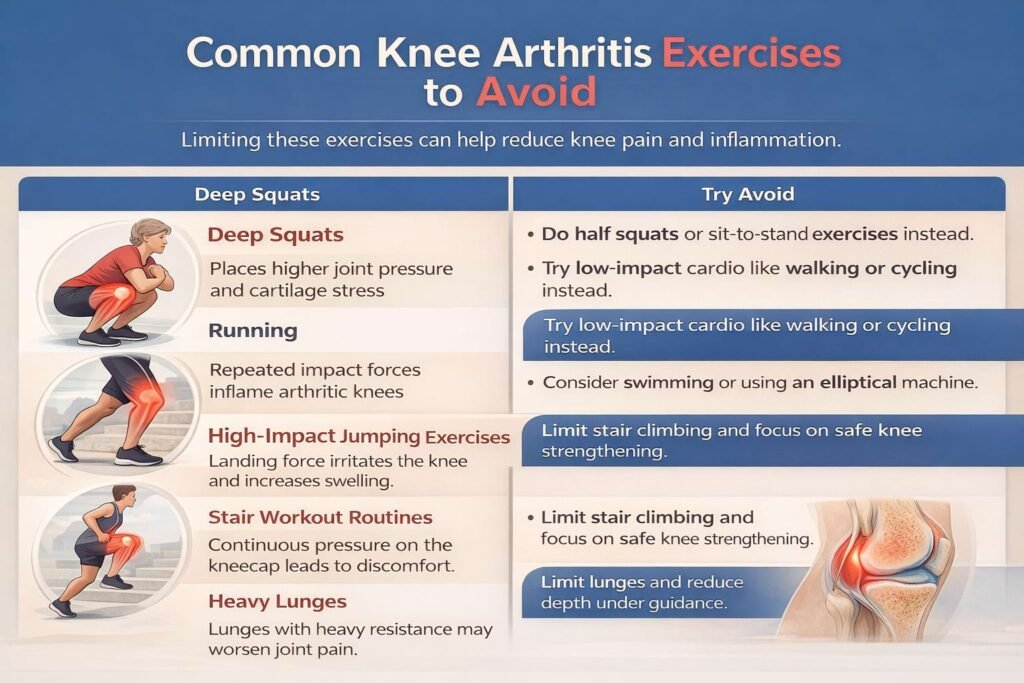
Common Knee Arthritis Exercises to Avoid
Understanding knee arthritis exercises to avoid does not mean stopping exercise completely. In fact, regular movement helps maintain joint flexibility and muscle strength. The goal is simply to choose exercises that support the joint rather than overload it.
Several exercises are known to place extra stress on arthritic knees. Limiting or modifying these movements can help reduce pain and inflammation.
Deep Squats
Deep squats require the knees to bend beyond ninety degrees. At this angle, joint pressure increases significantly and the cartilage surfaces experience greater compression.
For individuals with arthritis, this position may irritate the joint lining. Many people notice swelling and stiffness developing later in the day after performing deep squats.
Physiotherapists often recommend replacing deep squats with controlled half-squats or supported sit-to-stand exercises. These changes are common when reviewing knee arthritis exercises to avoid a safer exercise plan.
Running With Knee Arthritis
Many people ask whether running with knee arthritis is safe. Running produces repeated impact forces every time the foot hits the ground. While this may be manageable for healthy joints, arthritic knees may respond differently.
When I review cases of individuals who run regularly despite arthritis, the most common complaints include joint stiffness, swelling after activity, and sometimes severe knee pain at night time. This nighttime discomfort usually happens because inflammation builds up after prolonged impact activity.
Switching to low-impact cardio exercises can often reduce stress on the joint while still providing cardiovascular benefits.
High-Impact Jumping Exercises
Jumping movements such as box jumps, jump squats, and skipping generate sudden impact forces that travel through the knee joint. These exercises are common in high-intensity fitness programs but may worsen arthritis symptoms.
For people with knee arthritis, the repeated landing forces may irritate the joint lining and increase swelling. Over time this can make everyday movement more uncomfortable.
Low-impact alternatives like swimming, elliptical training, or cycling provide similar fitness benefits without excessive joint stress.
Stair Workout Routines
Climbing stairs occasionally is part of normal daily activity. However, repetitive stair workouts may aggravate arthritis symptoms because they place continuous pressure on the front of the knee joint.
Many individuals report knee pain stairs climbing when the joint becomes inflamed. Repeated stair exercises increase the load on the knee cap and surrounding structures, which may lead to discomfort.
Limiting stair workouts and focusing on controlled strengthening exercises may reduce irritation.
Heavy Lunges
Lunges place body weight directly onto the knee joint while the knee is bent. When performed with heavy resistance or deep bending, lunges may worsen hip and knee pain.
Some people can still perform modified lunges with reduced depth and proper guidance. However, they should be done carefully and ideally under physiotherapy supervision. In many cases, lunges are included in lists of knee arthritis exercises to avoid until pain and control improve.
Knee Exercises Versus Arthritis
- Exercise itself is not harmful for arthritis patients, and strengthening the muscles around the knee can improve stability and reduce joint stress.
- The main difference comes from exercise intensity and technique, because high-impact or deep bending movements may overload the joint.
- Controlled strengthening movements usually support joint health better and are often easier to manage.
- Many physiotherapy programs focus on the quadriceps, hamstrings, and hip muscles because these muscles help maintain knee alignment and distribute force during movement.
- Knowing the difference between safe exercises and knee arthritis exercises to avoid can make these programs more effective.
Knowing the difference between safe exercises and knee arthritis exercises to avoid helps make these programs more effective.
Physiotherapy Exercise for Knee Pain
Doctors frequently recommend physiotherapy exercise for knee pain as a first step in arthritis management. Physiotherapy programs are designed to improve joint stability while reducing inflammation.
These exercises often focus on strengthening muscles, improving balance, and maintaining joint mobility. Common movements include straight leg raises, seated knee extensions, and gentle hamstring stretching.
These exercises strengthen the legs without placing excessive pressure on the joint surfaces. Over time they can improve walking ability and reduce stiffness.
NHS Knee Exercises
The NHS also provides recommended nhs knee exercises that help people manage arthritis symptoms safely. These exercises focus on simple movements that maintain flexibility and muscle strength.
Examples include knee straightening movements, supported squats, and gentle stretching routines. These exercises are designed to keep the joint moving while preventing stiffness.
When I compare these exercises with high-impact workouts, the difference is clear. Controlled movements support recovery, while intense workouts may worsen symptoms.
Knee Swelling Exercises
Swelling is a common symptom of arthritis. When inflammation appears, gentle knee swelling exercises may help restore joint mobility.
Slow knee bending movements, leg elevation exercises, and light stretching can improve circulation and reduce stiffness. These movements help the joint recover after irritation. They can also be useful after accidentally doing knee arthritis exercises to avoid having the joint flared.
Hip Osteoarthritis Exercises to Avoid
Many arthritis patients experience problems in both the knee and hip joints. Understanding hip osteoarthritis exercises to avoid is important because hip weakness can influence knee mechanics.
Exercises such as deep lunges, high-impact running, or heavy weighted squats may increase stress on both joints. When thehip muscles are weak, additional pressure transfers to the knee joint.
Strengthening the hips often improves knee stability and reduces pain during everyday activities.
Other Conditions That Affect Knee Pain
Knee pain does not always come directly from arthritis. Several other conditions may contribute to joint discomfort and influence exercise tolerance.
Knee Pain Postpartum
Some individuals experience knee pain postpartum after pregnancy. Hormonal changes may affect ligament stability, and additional weight during pregnancy increases stress on the joints.
After childbirth, gradual rehabilitation exercises can help restore muscle strength and joint stability.
Hip and Knee Pain Connection
The hip and knee joints work closely together during movement. If the hip muscles become weak, the knee may compensate by taking more load.
This explains why many people experience hip and knee pain at the same time. Improving hip strength can reduce pressure on the knee and improve overall movement patterns.
Severe Knee Pain at Night Time
Many arthritis patients report severe knee pain at night. This symptom often occurs because inflammation builds up throughout the day.
Reducing high-impact activities and performing gentle stretching in the evening may help reduce nighttime discomfort. This becomes even more important for people who have already done knee arthritis exercises to avoid earlier in the day.
Treatment Options for Knee Arthritis
Exercise is an important part of arthritis management, but sometimes additional treatments help improve comfort and mobility.
What Are the 3 Injections for Knee Pain
Patients frequently ask what are the 3 injections for knee pain. The most common options include corticosteroid injections, hyaluronic acid injections, arthosamide injection and hydrogel injections.

These treatments aim to reduce inflammation and improve joint lubrication.
Massage for Knee Pain
Another supportive therapy is massage for knee pain. Massage therapy improves circulation around the joint and helps relax tight muscles.
When combined with exercise and physiotherapy, massage can support overall knee comfort.
How to Relieve Hip and Knee Pain
Managing arthritis often requires multiple approaches. Gentle strengthening exercises, physiotherapy guidance, weight management, supportive footwear, and low-impact activities all play a role in reducing symptoms.
Learning which knee arthritis exercises to avoid is an important step in preventing further irritation and protecting joint health.
Arthrosamid Injection for Knee Pain
For individuals whose arthritis symptoms continue despite exercise and physiotherapy, advanced treatment options may be considered. One emerging option is Arthrosamid injection for knee pain.
Arthrosamid is a hydrogel injection designed to support the knee joint by improving cushioning inside the joint space. Unlike some treatments that provide short-term relief, this hydrogel integrates with the joint lining and helps reduce friction between joint surfaces.
Many patients consider Arthrosamid when conservative treatments are no longer providing enough relief. The goal is to improve comfort during everyday movement and support long-term joint function without surgery.
Choosing a nearby clinic for treatment often makes follow-up visits and recovery support easier, which is why arthosamide injection near me can be useful when looking for local care.
What are knee arthritis exercises to avoid?
High-impact exercises such as deep squats, jumping workouts, and intense running may worsen arthritis symptoms because they increase pressure on the knee joint.
Is bike riding good for arthritic knees?
Yes. Many doctors say bike riding is good for arthritic knees because cycling provides low-impact movement that strengthens muscles without stressing the joint.
Can physiotherapy exercises help knee arthritis?
Yes. Physiotherapy exercises for knee pain help strengthen the muscles around the knee and improve joint stability.
Why does knee pain get worse at night?
Inflammation and joint fatigue during the day may lead to severe knee pain at night, especially if the knee was overused earlier.
Are NHS knee exercises helpful?
Yes. nhs knee exercises focus on gentle strengthening and flexibility movements that support arthritis management.
Knowing the knee arthritis exercises to avoid is a simple but powerful step toward protecting your knees and maintaining an active, pain-free lifestyle.
Read more: New non-surgical knee pain treatments in UK 2026 with Arthrosamid injection
Read more: Arthrosamid Injection London: What Patients Need to Know


