
knee pain treatment has moved in a more practical direction in 2026. The basics still matter. But assessment is often quicker. Guided injections are more widely offered in private settings. Longer-lasting joint gel options are also part of routine discussion now. The result is less time guessing and more time following a plan that matches what is actually driving pain.
Many people now look for a non-surgical option that supports daily walking and stairs for longer. This is especially true when knee osteoarthritis symptoms keep returning. In 2026, that often leads to newer hydrogel choices such as Arthrosamid injection. This treatment aims to cushion the joint and support more comfortable movement over time. It is often discussed when pain and stiffness continue despite rehab and load control. It can also be considered when the goal is to improve function while keeping surgery as a later option.
Learn more about the pricing for arthosamide injection cost uk and suitability. Read more about arthosamide injection london and how the treatment is planned based on symptoms and joint stage.
Knee pain in 2026 and why the best results start with the cause
Knee pain is not one condition. A sore knee after a long walk is different from a knee that swells after stairs. Both are different again from sharp pain after a twist. Pain location, swelling pattern, stiffness pattern, and load tolerance usually shape the treatment route far more reliably than the pain score alone.
Most credible pathways still begin with a structured assessment and conservative care. This is especially true when osteoarthritis sits in the background. Guidance continues to emphasise therapeutic exercise and weight management when appropriate. Stronger muscles and reduced load often improve function and symptoms.

When a faster clinical check matters
A complete knee pain treatment guide should also flag the patterns that call for a quicker assessment. Sudden major swelling is one example. A hot knee with fever is another. An inability to bear weight after injury should also be checked. The same applies to a knee that locks and cannot fully straighten. These patterns should not be managed by “rest and hope.”
Ongoing night pain that repeatedly disrupts sleep is also a signal to take action. Swelling that keeps returning despite simple load reduction can be another reason. In these cases, it makes sense to move from self-care to a structured plan.
How modern clinics decide the next step
Symptom pattern matters more than the pain score
The “pattern” often reveals the likely driver. Pain that is worse after sitting and eases after warming up often behaves differently from pain that spikes only during impact sport. Swelling that arrives hours after activity may suggest the joint is struggling with load. It may also be behaving like an osteoarthritis flare.
A sharp pain after a twist with catching can point to a different mechanical issue. Clear pattern recognition reduces wasted time. It also reduces the chance of using procedures when strength work and load control would have solved the problem.
Imaging matters when it affects treatment decisions
In private MSK settings, ultrasound or other imaging is often used to confirm effusion, synovitis, bursitis, tendon issues, or to guide an injection more precisely. Imaging is not always needed. But it can be useful when the findings will change the plan. It can also help when accurate injection placement is important for symptom control.
Common knee pain treatment categories in 2026
In 2026, knee pain treatment commonly falls into four categories.
- Non-surgical knee pain treatments UK usually start with foundational rehab. This includes strengthening the muscles around the knee and hip. It also includes improving control and balance. Daily load is adjusted so flare-ups reduce over time. The goal is to make walking, stairs, and normal activity easier without jumping straight to procedures.
- Medication support may be used when needed to make movement possible, especially during flare patterns. It is usually used to support activity and rehab, not replace it, because long-term improvement still depends on better strength and load tolerance.
- knee pain injections UK are often considered when pain or swelling blocks progress. Injections can reduce symptoms and create a “working window” where exercise becomes manageable again. Options may include hyaluronic acid knee injections UK for joint support in osteoarthritis patterns, depending on suitability.
- Surgery is usually discussed when symptoms remain severe despite other knee pain treatments UK. It is generally considered after conservative care and injection options have been explored, especially when function and quality of life stay significantly limited.
Foundational care that still does the heavy lifting
Strength and control training
For many knees, symptoms reduce when the joint stops taking all the load alone. Quadriceps strength, hip control, calf capacity, and balance work matter because they change walking mechanics and stair tolerance. This is also consistent with the wider message that strengthening and staying active support joints and can improve osteoarthritis symptoms over time.
Improvement often comes from consistency rather than intensity. A calm, repeatable plan beats occasional bursts of effort followed by long gaps. When flare patterns exist, pacing and progression matter more than “pushing through.”
Load planning instead of full rest
Full rest for weeks rarely helps long-term. A knee that is irritated usually benefits from movement, but it often needs a temporary reduction in the movements that spike symptoms. Deep bending under load, repeated stair sessions, long downhill walks, and sudden jumps in training volume are common triggers.
A practical plan keeps movement going while reducing spikes. That can mean shorter walks more often, flatter routes, controlled strength work, and gradual reintroduction of the movements that currently trigger pain.
Pain relief support without overcomplication
Pain relief options sometimes support activity and rehab, especially when pain blocks sleep or basic movement. Clarity matters because confusion leads to avoidance, and avoidance often leads to stiffness and deconditioning. For osteoarthritis, the focus remains on keeping movement possible, rather than chasing a perfect “pain-free” day.
Why injections are used and when they make sense
Knee pain injections UK remain popular because they can reduce pain enough to restore movement and allow rehab to progress. The most common injection categories discussed across providers include corticosteroid injections, hyaluronic acid knee injections UK, PRP, and hydrogel options such as Arthrosamid.
Injections work best when the goal is clear. They can reduce symptoms so walking becomes easier, stairs become manageable, and strength work becomes realistic again. They do not replace rehab, but they can create a window where rehab is actually possible.
Corticosteroid injections and fast relief for flare patterns
Steroid injections are often used for inflammatory flare patterns, aiming to reduce inflammation and pain. Benefits can be meaningful but may be shorter-lived, and suitability depends on the clinical picture and medical history. This is why assessment matters before choosing an injection type.
Hyaluronic acid knee injections UK and where this sits in 2026
Hyaluronic acid knee injections UK are still widely offered in private care and discussed in arthritis resources as a joint-fluid support option. Results vary between individuals, and response is not guaranteed.
At the same time, guideline discussions can be cautious. NICE rationale notes a lack of evidence showing that hyaluronan injections improved quality of life, physical function, or pain outcomes for knee or hip osteoarthritis in the evidence reviewed, which is one reason practice varies by setting.
That mix is part of 2026 reality. Some patients report benefits, some do not, and evidence summaries can differ from marketing language. The most useful approach is straightforward: set expectations clearly, use injections to support movement, and keep rehab as the base.
Non-surgical knee pain treatments UK and what non-surgical really includes
Non-surgical knee pain treatments UK usually start with a rehab plan, smarter activity changes, and load management so the knee can tolerate daily walking and stairs with fewer flare-ups. Supports like braces can help in the right cases, especially when stability or alignment support is needed.
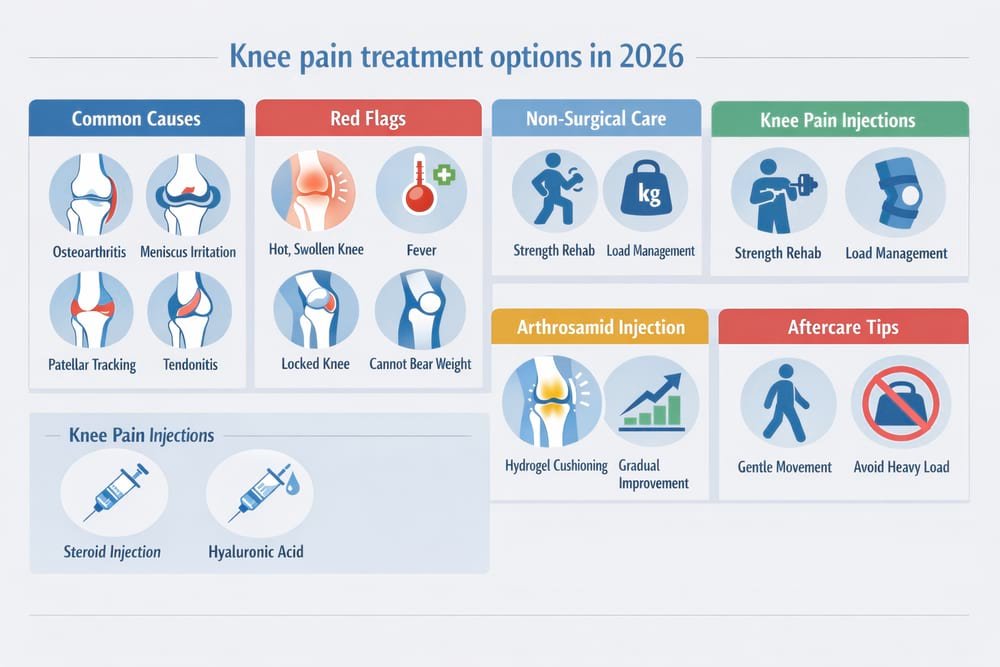
When pain or swelling blocks progress, knee pain injections UK may be added to reduce symptoms and help movement continue. For osteoarthritis patterns where conservative care has plateaued, a longer-lasting option like Arthrosamid injection may be considered to support comfort and function without surgery.
Arthrosamid injection UK 2026 guide with real benefits
In 2026, more attention has shifted to longer-lasting relief without surgery. Arthrosamid injection fits that conversation because it is described as a soft gel injected into the knee joint to cushion the joint and support more comfortable movement. Imperial’s private service describes the process as local anaesthetic followed by injection of a soft gel, with less pain often noticed within four weeks.
Benenden Hospital also describes Arthrosamid as an injectable gel used for knee osteoarthritis symptoms without surgery, often positioned as a single-injection option intended to reduce stiffness and pain.
Arthrosamid knee injection UK and how the appointment usually works
Arthrosamid knee injection UK is typically done as a short outpatient procedure. Assessment and consent come first. The skin is cleaned, local anaesthetic is used to numb the area, and the gel is injected into the joint. Many providers describe using guidance to support accurate placement, especially when swelling or anatomy makes landmarks difficult.
After the injection, most people leave with aftercare advice focused on keeping the day calm, avoiding heavy loading briefly, and then returning to normal walking and rehab in a controlled way.
Arthrosamid treatment for knee pain and benefits that matter in real life
Arthrosamid treatment for knee pain is mainly discussed for osteoarthritis patterns where walking, stairs, and daily function are being limited. The benefits that matter are practical.
Reduced pain can make movement possible again. Movement is usually the engine of improvement, especially when rehab work has stalled because the knee refuses to cooperate. A second benefit is the “window” created for strength and control training. When pain is lower, rehab becomes easier to follow, and consistency improves. A third benefit is the longer-lasting intent described by providers, with Arthrosamid positioned as cushioning support rather than a short-lived flare-calmer.
This is also why the search interest is so strong around pricing and location. People are often comparing how long relief may last, how quickly normal activity returns, and whether the plan can help delay surgery while keeping life moving.
Arthrosamid knee osteoarthritis treatment UK and who tends to be considered
Arthrosamid knee osteoarthritis treatment UK is commonly positioned for persistent osteoarthritis symptoms where core conservative measures have been tried and function is still limited. Stiffness, joint-line ache, reduced walking tolerance, and repeated flare patterns often sit in this group.
It is generally framed as an option when conservative care has plateaued rather than as a first step, particularly when the goal is to improve function and keep surgery as a later option.
Arthrosamid side effects UK and Arthrosamid recovery time
Arthrosamid injections are usually well tolerated, but short-term side effects can happen. Most are mild and settle within a few days.
Possible side effects include
- Temporary pain or soreness at the injection site
- Mild swelling in the knee
- A feeling of fullness or heaviness in the knee
- Short-term stiffness
- Mild tenderness or warmth around the knee
- Small bruise or mild redness near the injection area
- Brief flare-up where pain feels slightly worse for a short time before settling
- Rare allergy-type reaction such as itching or a rash
- Very rare but serious infection warning signs such as fever, increasing redness, worsening swelling, and severe pain
Arthrosamid recovery time is usually short for normal daily activity, but heavy loading is often reduced briefly. The key expectation is timeline. Improvement is commonly described as building over weeks rather than appearing instantly, with some providers describing noticeable improvement within around four weeks.
Comparing non-surgical options and where Arthrosamid fits in 2026
A clear knee pain treatment plan usually starts with assessment, rehab, and load control. When pain or swelling blocks progress, knee pain injections UK may be used to reduce symptoms so walking and exercise can continue.
In 2026, Arthrosamid is discussed more because it is a hydrogel option aimed at longer-lasting support for osteoarthritis symptoms. Arthrosamid knee injection UK is often considered when stiffness and joint-line ache continue despite conservative care. The goal of Arthrosamid treatment for knee pain is practical: cushioning support inside the joint so movement feels easier over time, helping rehab stay consistent.
Arthrosamid side effects are usually short-term local soreness or swelling, and Arthrosamid recovery time is generally quick for normal daily activity, with heavy loading reduced briefly.
knee pain treatments UK and comparing injection categories without hype
knee pain treatments UK are often compared using a “which is best” framing, but selection depends on pain driver, joint stage, and goals.
Steroid injections are often framed as quicker relief for inflammatory flare patterns but potentially shorter-lived benefit.
Hyaluronic acid injections are framed as joint support, but guideline discussions can be cautious, so recommendations vary.
Arthrosamid is framed as a longer-lasting hydrogel option for osteoarthritis symptoms and is often positioned between short-term injections and surgery in private care descriptions.

FAQ
How long do knee pain injections take to work and how long do they last?
Most injections do not work the same way. Some can reduce symptoms quickly, while others build gradually over weeks. Duration depends on the injection type, the stage of joint change, and daily load.
Can hyaluronic acid knee injections UK be used with physiotherapy and strength training?
Yes, they are often used to reduce symptoms so exercise becomes easier. Best results usually come when rehab continues consistently after symptoms settle.
Who is not suitable for Arthrosamid injection in the UK?
Suitability depends on diagnosis, knee condition, infection risk, and overall health factors. A proper assessment is needed before deciding, especially if there is a recent infection, severe swelling with fever, or unclear diagnosis.
What should be avoided during Arthrosamid recovery time
Heavy loading, high-impact exercise, and deep knee bends are usually reduced briefly. A gradual return to walking and a structured rehab plan is often recommended to get the best outcome.
knee pain treatment works best when symptoms are controlled enough to keep movement consistent, because the knee often improves when it is used well rather than avoided completely. Exercise-led care remains central for osteoarthritis, guided injections remain a common step-up, and longer-lasting hydrogel injections have become a bigger part of private treatment conversations.
For osteoarthritis symptoms where conservative care has stalled, Arthrosamid is often described as a strong non-surgical option because it aims to cushion the joint and support more comfortable movement over time.
Read more: Knee Pain in Ladies: Causes and Treatments
Read more: Recognizing Knee Osteoarthritis and How Arthrosamid Injection London Help


