Single Injection For Knee Osteoarthritis Offers Real Relief

✅ Medically reviewed | Updated August 2026
A single injection for knee osteoarthritis has become one of the most searched treatment questions among UK patients today. Repeated clinic visits are not always practical for people managing work, family, and daily pain. Mild-to-moderate knee osteoarthritis often responds well to targeted, one-visit injection treatments. Three distinct product categories currently fall under this label, each working through a different mechanism. None of these categories replaces surgery for advanced disease, and accurate staging matters before any decision is made.
Why A Single Injection For Knee Osteoarthritis Appeals To Patients
Multiple hospital visits create a genuine barrier to treatment completion. Missed workdays, travel costs, and repeated discomfort discourage many people from finishing a full injection course. A single injection for knee osteoarthritis removes that burden almost entirely. One appointment, one procedure, and a monitored recovery period follow.
Three Categories, One Visit
- Hyaluronic acid injection knee products lubricate the joint directly
- Arthrosamid, a polyacrylamide hydrogel injection, integrates structurally with the joint lining
- PRP injection for knee pain uses concentrated platelets drawn from a simple blood sample
Each mechanism differs considerably, yet all three fit neatly within one clinic visit. This appeals strongly to working adults and older patients with limited mobility. None of these knee OA treatment options suit advanced, bone-on-bone knee arthritis, however. Patients need accurate imaging and staging before any injection decision gets made. That single distinction shapes every recommendation described throughout the sections below.
Who Benefits Most
Age, activity level, and prior treatment history all influence which category fits best. Many patients simply prefer avoiding needles multiple times within a short period. A single injection for knee osteoarthritis also reduces cumulative infection risk compared with repeated procedures. Fewer visits mean fewer opportunities for scheduling conflicts or missed sessions altogether.
Cost and logistics play a practical role too, particularly for patients travelling from outside London. A single trip reduces overall time away from work or family duties considerably. This practical appeal partly explains rising interest in knee OA treatment options across UK private clinics.
Hyaluronic Acid Injection Knee: The Long-Standing Option
Hyaluronic acid injection knee treatments, known clinically as viscosupplementation knee therapy, remain the most established single-dose category available. These products replenish synovial fluid, restoring lubrication that naturally declines as osteoarthritis progresses. Peak benefit typically arrives within four to six weeks of treatment. Pain relief and improved joint function often persist for around six months afterwards.
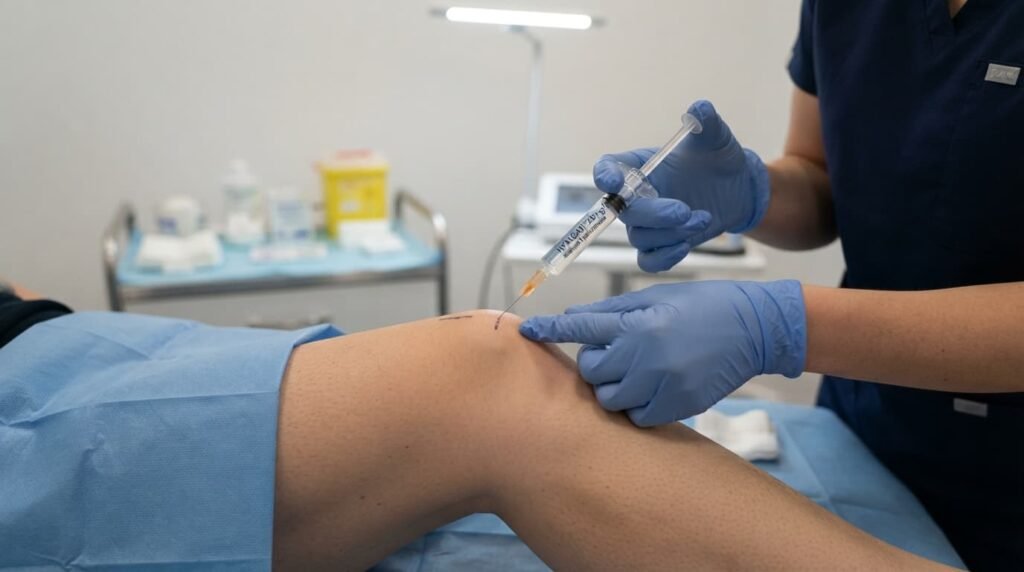
Durolane, Monovisc And Synvisc-One Compared
Three branded products dominate this category across UK clinics:
- Durolane uses NASHA cross-linking technology to achieve a concentrated single-dose formulation
- Monovisc is distinguished by unusually high molecular weight, requiring only one syringe per treatment
- Synvisc-One derives from avian sources, carrying a marginally higher allergy risk for sensitive patients
Bacterial-fermentation products like Durolane and Monovisc avoid that specific allergy concern entirely. Product-level differences remain modest overall, and no consistent head-to-head advantage has emerged. Clinicians therefore select based on patient history, prior reactions, and clinic availability.
The Evidence Is Genuinely Mixed
Clinical evidence for single-dose hyaluronic acid injections for knee osteoarthritis remains mixed, it must be said. Some systematic reviews found no consistent advantage over multiple-dose regimens across similar patient groups. Other older analyses showed multi-injection courses outperforming saline, while single doses sometimes missed statistical significance. Patients deserve this honest context before committing to any single treatment pathway.
A 2024 retrospective study confirmed that one hyaluronic acid injection significantly reduced pain within four weeks. Muscle strength improvements were smaller and did not always reach statistical significance at that same timepoint. Both major orthopaedic bodies still describe the overall evidence base as modest rather than definitive.
Patients with mild inflammation and early cartilage changes tend to respond most consistently. Those already approaching bone-on-bone knee arthritis typically see smaller, shorter-lived improvements from hyaluronic acid alone.
Arthrosamid And Polyacrylamide Hydrogel Injection
Arthrosamid represents a structurally different approach among knee injection options for arthritis. Rather than supplying lubricating fluid, this polyacrylamide hydrogel injection becomes a permanent part of the joint lining itself. Delivered through an ultrasound-guided knee injection technique, the six-millilitre gel integrates with synovial tissue. It does not simply float within joint fluid.

Duration And Availability
Because the hydrogel does not biodegrade, duration extends well beyond typical hyaluronic acid timelines. Observational studies suggest benefits lasting three to five years in many treated patients. Arthrosamid injection treatment is now widely available across UK specialist clinics. It currently lacks FDA approval in the United States.
What The Trial Data Show
A landmark open-label study followed forty-nine patients with a mean age of seventy years. Results showed meaningful pain reduction sustained across a full year of follow-up. Stiffness, physical function, and overall patient assessment scores all improved consistently across that same period. The evidence remains promising, though larger placebo-controlled trials are still genuinely needed.
For patients considering Arthrosamid treatment, that permanence works both ways. The gel cannot be removed once injected into the joint space. Hyaluronic acid, by comparison, simply wears off naturally over roughly six months. This distinction matters considerably when weighing long-term commitment against reversibility.

PRP Injection For Knee: Platelet-Rich Plasma Knee Osteoarthritis Care
Platelet-rich plasma knee osteoarthritis treatment draws directly from the patient’s own blood supply. A small sample gets centrifuged, concentrating platelets rich in natural growth factors. This concentrate is then injected precisely into the affected knee joint. Unlike hyaluronic acid or Arthrosamid, PRP injection for knee treatment works through a biological rather than mechanical process.
Reported benefit duration ranges from six months to over a year in suitable candidates. Early-to-moderate osteoarthritis tends to respond considerably better to this particular approach. Results in advanced disease remain noticeably weaker and less predictable across published research studies.
Why Preparation Protocols Matter
Preparation protocols vary enormously between clinics, and that variation genuinely matters clinically. Platelet concentration, leukocyte content, and activation methods all differ from centre to centre. Leukocyte-rich and leukocyte-poor preparations behave quite differently once inside an inflamed joint.
Patients should always ask how their specific PRP preparation gets produced before treatment begins. For a fuller look at how these mechanisms differ, PRP compared against Arthrosamid offers useful additional detail worth reading.
Interest in PRP injections for knee osteoarthritis has grown steadily across UK regenerative medicine clinics in recent years. Many patients are drawn by the autologous nature of the treatment, since nothing synthetic enters the joint. That biological appeal, alongside a reasonable safety profile, keeps demand strong despite the variability described above.
A short clinical explainer on the Dr SNA Clinic YouTube channel covers non-surgical arthritis treatment approaches in genuinely accessible detail. It offers a useful visual companion to the mechanisms described throughout this section.

Knee Joint Injections Comparison: Duration, Evidence And Access
No single trial has directly compared all three treatments within one shared patient group. Any knee joint injections comparison therefore relies on separate bodies of evidence rather than true head-to-head data. That limitation deserves acknowledgement before drawing firm conclusions between categories.
Duration And Reversibility
Duration and reversibility separate these three options most sharply of all. Hyaluronic acid provides roughly six months of relief, repeatable if the first course works well. PRP may extend that window past a year for certain responsive patients. Arthrosamid’s non-degrading structure supports observed benefits lasting three to five years, though it genuinely cannot be undone once placed.
Evidence Quality
Hyaluronic acid carries the largest randomised trial base of the three options discussed. Single-injection data specifically, however, remain contested within that broader evidence picture. Arthrosamid evidence looks encouraging overall but currently lacks placebo-controlled trial support. PRP randomised data certainly exist, yet pooling results remains difficult given inconsistent preparation methods.
Access And Knee Injection Cost
Hyaluronic acid products remain widely stocked and are sometimes insurer-covered across the UK. Arthrosamid remains a specialist-only procedure across most current UK clinics. PRP pricing and availability vary considerably by centre, meaning direct comparison requires individual consultation.
For patients exploring non-surgical knee osteoarthritis treatment broadly, understanding these trade-offs matters more than chasing one universal “best” answer. The right choice depends heavily on OA severity, activity level, and personal treatment goals. A combined injection therapy approach, blending two categories sequentially, occasionally suits certain patients. Those who respond only partially to a single option may benefit most.
Knee OA Treatment Options: Who Should Avoid Single Injections
Advanced, bone-on-bone knee arthritis does not respond reliably to any of these three treatment categories. X-ray imaging remains the primary tool for confirming that particular severity level accurately. Once bone-on-bone changes appear clearly, conversation typically shifts toward surgical planning rather than injection therapy.
Certain other factors rule out treatment regardless of the underlying OA stage:
- Active joint infection
- Blood clotting disorders
- Known product sensitivities
A thorough clinical history should always precede any knee pain relief injection decision made with a patient. Younger, highly active patients occasionally present a different consideration too. Mechanical loading from sport or physical work can shorten the effective duration of any injection type.

When A Second Opinion Helps
Patients who have already tried one injection category without success often benefit from a fresh assessment. Symptoms sometimes stem from a different structure entirely, such as a meniscal tear rather than pure osteoarthritis. A second, structured review can prevent repeated treatment of the wrong underlying problem. It also confirms whether a different single injection category might suit the joint better.
Getting Assessed Before Choosing Ultrasound-Guided Knee Injection
Imaging Comes First
Assessment begins with imaging in almost every reputable UK clinic setting. X-ray confirms joint space narrowing and overall disease stage with reasonable accuracy. Where results appear ambiguous, MRI adds valuable soft-tissue detail, particularly around meniscal involvement.
Technique Matters As Much As Product
Technique matters just as much as product selection during any procedure. Ultrasound-guided knee injection accuracy ensures the treatment actually reaches the intended joint space precisely. Product placed outside that space simply cannot work effectively, regardless of category chosen.
A structured specialist review typically follows one consistent, logical sequence. Joint status comes first, clinical fit follows second, and product selection comes third. That order applies whether patients are exploring their very first injection or reconsidering treatment after previous options. Knee pain affecting older male patients often benefits from this same structured approach.
Preparing For The First Consultation
Bringing prior imaging, a symptom timeline, and a list of previous treatments speeds up that first consultation considerably. Clear communication about daily activity levels also helps clinicians match expectations realistically. Noting which treatments have already been tried and how the joint responded adds valuable context too.
Follow-up review after treatment matters too, though it rarely requires another injection immediately. A short check-in at four to six weeks confirms whether the chosen product is working as expected. Adjustments to physiotherapy or activity levels sometimes follow that review, supporting the injection’s overall effect. This ongoing dialogue between patient and clinician often shapes longer-term outcomes considerably.
Frequently Asked Questions
What is a single injection for knee osteoarthritis?
A single injection for knee osteoarthritis is a one-visit treatment that directly addresses joint pain and stiffness. Hyaluronic acid, Arthrosamid, and PRP all qualify comfortably under this broad category. Each works through a distinct mechanism suited to different patient profiles and goals.
How does hyaluronic acid injection knee treatment compare with Arthrosamid?
Hyaluronic acid injection therapy for the knee lubricates the joint for approximately 6 months at a time. Arthrosamid instead integrates structurally, supporting benefits that can last several years afterwards. The right choice depends largely on desired duration and personal reversibility preferences.
Is PRP injection for knee pain suitable for every patient?
PRP injection for knee pain tends to work best in early-to-moderate osteoarthritis cases specifically. Results in advanced, bone-on-bone knee arthritis are typically weaker and less consistent overall. A specialist assessment always confirms individual suitability before any procedure proceeds.
Why does ultrasound-guided knee injection technique matter so much?
Ultrasound-guided knee injection accuracy ensures the chosen product reaches the correct joint space precisely. Product delivered outside that exact space cannot work effectively, no matter how good it is. This principle applies consistently across every injection category compared throughout this article.
What affects knee injection cost and overall accessibility?
Knee injections vary by product type, clinic location, and individual treatment plan across the UK. Hyaluronic acid remains the most widely available and occasionally insurer-supported option currently. Arthrosamid and PRP availability depends more heavily on individual specialist clinic provision.
Single injection for knee osteoarthritis treatment now spans three genuinely different mechanisms suited to different needs. Hyaluronic acid, Arthrosamid, and PRP each offer distinct duration, evidence strength, and practical trade-offs worth weighing carefully beforehand. Mr Syed Nadeem Abbas specialises in non-surgical knee osteoarthritis assessment and personalised injection therapy.
Read more: Does Stem Cell Therapy for Knees Actually Work?
Read more: Knee Cartilage Damage Causes Pain, Stiffness and Reduced Movement