NHS Knee Replacement Waiting Time and How to Manage It

✅ Medically reviewed | Updated August 2026
The NHS knee replacement waiting time currently sits well beyond the official 18-week standard for most patients. The NHS knee replacement waiting time currently sits well beyond the official 18-week standard for most patients. Trauma and orthopaedic waiting lists across England remain among the largest in the health service. Knee replacement is one of the most requested procedures on them. A referral date does not mean surgery is close. It usually marks the start of a long holding period that carries its own risks if left unmanaged. Understanding this waiting period properly changes how it is spent.
How Long Is the NHS Knee Replacement Waiting Time Right Now
The NHS Constitution sets an 18-week target for consultant-led treatment, measured from referral to the first stage of surgery. In practice, the average NHS knee replacement waiting time now runs closer to seven months than four. Trauma and orthopaedics remains the single largest speciality waiting list in England, with knee and hip replacement forming a substantial share of it.
Regional variation is significant. Two patients referred in the same week, in different parts of the country, can face waits that differ by months. This is one reason checking a personal position on the list matters more than relying on national averages. It is also why the true wait can feel unpredictable even within a single trust.
Checking a Personal Position on the List
The NHS App displays referral status and estimated timeframes for most trusts. A patient uncertain about progress should not wait for a scheduled letter before asking. A short call to the booking team, or a message through the app, usually gets a direct answer. Patients also have the right to ask for a transfer to a different trust if a shorter wait is available elsewhere, and a GP or referring clinician can support that request.
Why Knee Osteoarthritis Leads to Surgery
Osteoarthritis knee treatment usually starts with the least invasive options and moves upward only when those stop working. Cartilage loss, bone changes and joint stiffness tend to progress gradually, and most people manage symptoms for years using lifestyle changes, medication and physiotherapy before an operation becomes relevant.

A full replacement operation is typically considered once pain interferes with sleep, mobility or daily tasks. This applies despite trying other osteoarthritis treatment routes first. Surgery is not usually the first conversation a GP has about a painful knee. It should not be the only one either. A structured non-surgical plan, kept up consistently during the waiting period. It can also shape recovery afterwards. This is also where a long wait becomes less of a passive delay and more of a preparation window.
What Happens to a Knee During a Long Wait
Pain levels can appear stable for months even while joint function quietly worsens. This is a well-documented pattern in orthopaedic research. Muscle wasting around the knee, reduced range of motion and gradual loss of confidence in weight-bearing can all progress without a corresponding spike in reported pain.
Surgical outcomes are also affected by delay. Evidence submitted to parliamentary inquiries on NHS waiting times has pointed to worse post-operative results once a wait extends past roughly six months. Quality of life can decline too, with many patients reporting increased anxiety alongside physical decline. A place on the list is not a pause button on the condition, and treating the NHS knee replacement waiting time as dead time tends to work against the eventual outcome.
Osteoarthritis Pain Relief Medication While Waiting
Managing pain relief for knee osteoarthritis sensibly during a long wait supports two goals at once: comfort, and the ability to stay physically active.
Topical NSAID Knee Treatment and Capsaicin Cream
Topical NSAID knee gels, such as diclofenac, are generally recommended as a first pharmacological step for localised knee pain. NSAID cream for arthritis carries a lower systemic risk profile than tablets, since it targets the joint directly rather than passing through the whole body. It suits regular use for people managing symptoms over an extended period, particularly across a longer wait where daily comfort matters as much as long-term planning.
Capsaicin cream for arthritis works differently, dulling the nerve signals that transmit pain from the treated area. Some patients notice an improvement within two weeks, though full effect can take up to a month. A pea-sized amount applied a few times daily is the usual guidance, avoiding broken skin and sensitive areas.

Steroid Injections for Knee Arthritis
Steroid injections for osteoarthritis are generally reserved for flare-ups rather than routine ongoing use. A single steroid injection for knee arthritis can reduce swelling enough to let a patient re-engage with exercise, which matters more for long-term outcomes than the injection itself. It functions as a bridge back to activity rather than a standalone fix.
Oral NSAIDs sit as a second-line option if topical treatment is not sufficient, usually alongside a stomach-protecting medication. Osteoarthritis pain relief medication should always be reviewed with a GP, particularly for patients with existing cardiovascular, renal or gastrointestinal conditions.
Movement-Based Treatment and Structured Support Programmes
Exercise for knee osteoarthritis NHS guidance treats structured movement as a mandatory first-line treatment, not an optional add-on. A combination of aerobic activity and targeted muscle strengthening forms the backbone of current guidance, and starting early appears to matter. Research suggests people with shorter symptom duration gain more long-term pain relief from movement-based therapy than those who delay, which is a strong argument for beginning during the wait rather than after it ends.
A Structured Self-Management Route
One well-known example is the ESCAPE pain programme, a free NHS-supported six-week course combining self-management education with supervised circuit exercise, run twice weekly. It suits adults with chronic knee or hip pain and is available through GP referral, an MSK physiotherapist, or self-referral in many areas. A digital version exists for those unable to attend a physical class, and recent research has found similar formats produce meaningful short-term pain reduction.
Despite the evidence, uptake remains inconsistent, and many patients never receive a referral to this kind of programme automatically. Asking directly for MSK physiotherapy knee support, rather than waiting for a letter, often speeds things up.
Manual Therapy Physiotherapy Knee
Manual therapy physiotherapy knee sessions use hands-on stretching and mobilisation to reduce stiffness and preserve joint flexibility. It complements rather than replaces active exercise, and is usually delivered alongside a home exercise plan rather than instead of one.

Weight Loss and Knee Osteoarthritis
Weight loss and knee osteoarthritis outcomes are closely linked, since extra body weight increases mechanical load on the joint with every step. Even a modest reduction of five to ten per cent of body weight can measurably ease knee pain and improve function. A GP can refer eligible patients directly to a structured NHS weight management programme without needing a specialist appointment first, and combining this with exercise tends to produce better results than either approach alone.
Assistive Devices and Hot and Cold Therapy
Assistive devices for osteoarthritis range from shock-absorbing footwear and insoles to walking sticks, leg braces and splints. A stick held on the opposite side to the affected knee helps redistribute weight during walking. An occupational therapist can advise on devices for hand-operated tasks too, where osteoarthritis affects grip.
Hot and cold therapy for arthritis remains one of the simplest supportive measures available. A hot water bottle or microwaveable pack can ease stiffness, while a cold pack can calm swelling after activity. Neither replaces medication or exercise, but both offer quick, low-cost relief between sessions during a long wait for surgery.
Complementary Therapies and NICE Guidance
Osteoarthritis complementary therapies such as acupuncture are popular, but current NICE guidelines for knee osteoarthritis advice do not endorse them, citing insufficient evidence of benefit. The same applies to glucosamine and chondroitin for arthritis, which are no longer routinely prescribed on the NHS due to weak supporting data. Rubefacient creams fall into a similar category, with research showing little measurable effect on symptoms.
This does not mean every unproven therapy is without value to individual patients, but it does mean expectations should stay realistic, and a GP conversation before spending on supplements is worthwhile.
Injection Options Beyond Steroids
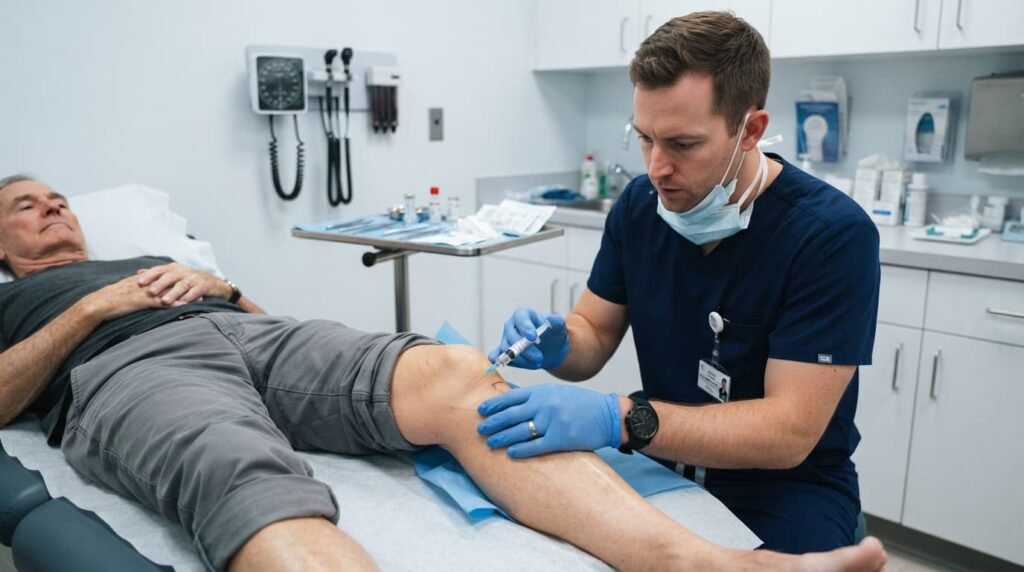
Beyond standard steroid injections, several other options exist for suitable candidates, each working through a different mechanism.
Hyaluronic Acid Injection Knee
A hyaluronic acid injection knee treatment, sometimes called viscosupplementation, aims to restore lubrication within the joint. It sits outside standard NHS pathways, so availability and suitability are usually discussed on a case-by-case basis with a specialist.
PRP Injection for Knee and Newer Hydrogel Options
A PRP injection for knee pain uses concentrated platelets drawn from the patient’s own blood to support the joint’s natural healing response. An Arthrosamid injection takes a different approach entirely. It introduces a polyacrylamide hydrogel that integrates permanently into the joint capsule rather than being gradually reabsorbed, which distinguishes it from shorter-acting alternatives. Suitability for this treatment is assessed individually, and it is worth exploring well before the end of a long wait rather than as a last resort.
Neither option sits within the standard NHS interim pathway, so both require a separate specialist assessment.
Surgical Options Beyond Total Replacement
Bone Realignment Surgery
An osteotomy involves adding or removing a small section of bone above or below the knee joint to shift weight away from the damaged area. It suits some younger or more active patients who are not yet candidates for full replacement, though it may only delay rather than avoid an eventual operation.
Radiofrequency Denervation Knee
Radiofrequency denervation knee treatment uses a targeted electrical current to disable specific pain-transmitting nerves around the joint. Relief can last up to two years, though nerves regenerate over time and the procedure may need repeating.
Full Knee Replacement
For many patients, joint replacement surgery remains the definitive option once conservative measures no longer control symptoms. An artificial joint typically lasts up to two decades, though newer resurfacing techniques exist for younger patients. Osteoarthritis surgery of any kind carries risks and recovery demands, which is why most surgeons exhaust non-surgical routes first, and why the wait beforehand is increasingly treated as an active phase of care rather than a queue to sit through quietly.
Managing the Wait on the List
Sitting on a knee replacement waiting list on the NHS record need not mean waiting passively. A few practical habits make a measurable difference to comfort and outcome.
- Check waiting list status through the NHS App rather than assuming no news is good news
- Ask about the cancellation list, since a short call can occasionally bring a date forward
- Keep a simple symptom diary noting pain, mobility changes and any new features
- Escalate promptly for sudden locking, rapid loss of weight-bearing ability, or numbness
- Request exercise therapy and MSK physiotherapy knee support directly rather than waiting for an automatic referral
Patients managing a long wait for surgery often find that combining several of these steps, rather than relying on one alone, makes the biggest difference to how the period actually feels. The Dr SNA Clinic YouTube channel walks through several of these procedures visually.

Frequently Asked Questions
How long is the NHS knee replacement waiting time on average?
The constitutional standard is 18 weeks, but the current average typically runs closer to seven months. Regional variation between trusts can add several more months to that figure. Checking a personal position through the NHS App gives the clearest and most accurate picture.
Can knee osteoarthritis exercises really make a difference while waiting?
Yes. Structured movement is linked to slower functional decline during a long wait. Programmes combining education with supervised circuit training tend to produce the strongest results. Starting early in the waiting period appears to matter more than starting later.
Is an Arthrosamid injection available on the NHS?
It sits outside the standard NHS pathway. Access is typically arranged through a private specialist assessment rather than a routine referral. A consultation can confirm whether this treatment suits a particular patient’s knee.
What pain relief for knee osteoarthritis is recommended first?
A gel applied directly to the joint is usually the first pharmacological step. Oral tablets are considered next if the gel alone is not sufficient. Occasional steroid injections may follow for flare-ups that limit movement or exercise.
Does NICE guidance support supplements like glucosamine for knee osteoarthritis?
No. These supplements are no longer routinely recommended by current guidance. Evidence has not shown a meaningful benefit at standard doses. A GP conversation is worthwhile before spending money on any supplement.
When might a bone realignment procedure be considered instead of full replacement?
An osteotomy may suit younger or more active patients who are not yet ready for a full replacement, though it may only delay rather than prevent the eventual need for surgery.
The NHS knee replacement waiting time rarely moves as fast as patients hope, but the months on the list need not be spent passively. Pain relief medication, structured exercise, weight management and, where appropriate, injectable options such as Arthrosamid can all support comfort and mobility long before a surgical date arrives. Approached this way, the wait becomes part of the treatment plan rather than an obstacle to it.
Mr Syed Nadeem Abbas and the team offer further guidance on non-surgical and injectable options for patients navigating that wait.
Read more:n Subchondral Sclerosis in Knee Osteoarthritis Causes Stiffness And Bone Thickening
Read more: Single Injection For Knee Osteoarthritis Offers Real Relief