✅ Medically reviewed
Arthrosamid NHS access is limited because the injection is not part of routine knee osteoarthritis care in England. The treatment is a polyacrylamide hydrogel. A clinician places it inside the knee joint under ultrasound guidance. It aims to ease pain and stiffness, and it does not repair cartilage.
The gel is on sale in the UK, but market approval differs from NHS funding. National bodies decide funding separately, using evidence and value for money. At present, most patients who receive the injection pay privately. The picture can shift as research develops, so the current status deserves a check before any plan is made.
What Arthrosamid Does Inside an Osteoarthritic Knee
Knee osteoarthritis wears down the joint surfaces over time. Pain, stiffness, and swelling usually follow. Many patients therefore look for options that sit between exercise and surgery. The hydrogel targets symptoms rather than the wear itself.
How the Hydrogel Works
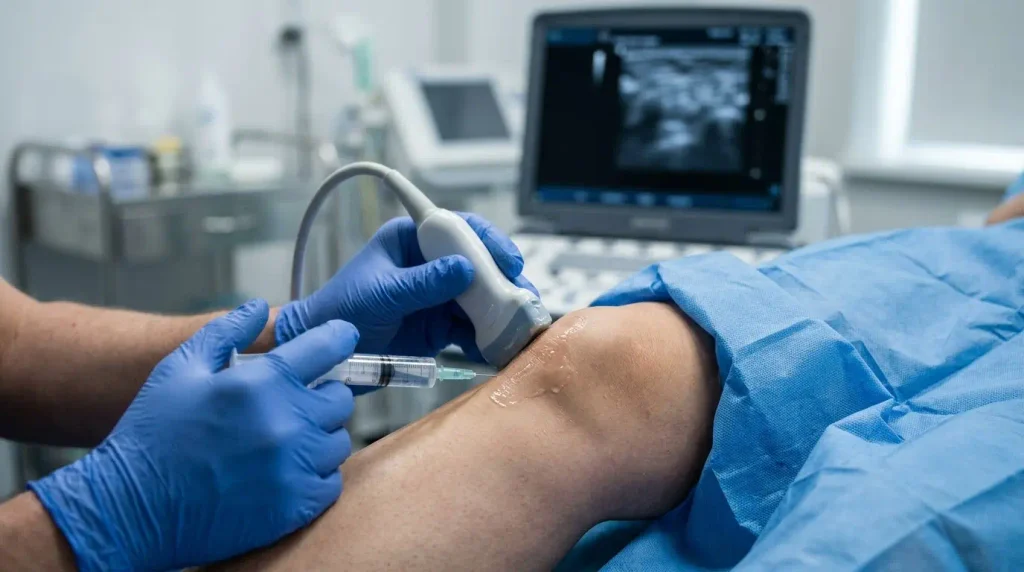
Arthrosamid is a soft gel made mostly of water. A cross-linked polyacrylamide structure holds that water in place. A clinician injects the gel into the joint under ultrasound guidance. It settles into the joint capsule and stays there instead of dissolving.
The aim is symptom relief, not cartilage repair. Patients often ask about safety and recovery before funding even comes up.
Where the Injection Fits in Knee Care
Most care plans start with exercise, weight management, and pain relief. Steroid injections come next for flare-ups. Surgery follows when other measures stop working.
The hydrogel sits between injections and surgery. Specialists usually consider it for mild to moderate osteoarthritis. It is the middle child of knee care: not the first option and not the last resort.
Is Arthrosamid Available on the NHS Today
The injection is not routinely funded by the NHS for knee osteoarthritis. Local research or special arrangements can differ, so details vary by area.
Current NHS Position
Arthrosamid NHS commissioning has not happened at national level. A standard GP referral does not lead to the injection in most areas. Arthrosamid on the NHS therefore stays rare, and mostly linked to research settings.
Arthrosamid NHS availability also depends on local policy. A GP or orthopaedic team can confirm what exists nearby. Patients should ask directly rather than assume a refusal.
NICE Guidance: Arthrosamid Status and Evidence Gaps
NICE reviewed the injection through its technology prioritisation process. The topic was not selected for a full Health Technology Evaluation. The recorded reason was insufficient evidence.
That wording has a narrow meaning. Published studies report encouraging symptom relief, but most are small and open-label. Open-label studies lack a blinded comparison group, which limits how firmly results can be read.
A decision about evidence maturity is not a verdict on safety. Arthrosamid NHS funding could change if stronger trial data emerge. NICE can revisit a topic when new evidence appears.
Research Within the NHS
An Arthrosamid NHS study ran at the Robert Jones and Agnes Hunt Orthopaedic Hospital. It examined the hydrogel in a UK patient group. Published summaries indicate that recruitment has since closed.
Research participation is not the same as routine funding. Hospitals do not offer the injection as standard care simply because a study took place.
What the Published Evidence Shows So Far
Evidence explains the NICE decision, so it deserves a closer look. Early data come mainly from small, single-arm studies.
Twelve-Month Findings
One widely cited study followed 49 patients for 52 weeks after a single injection. Participants reported improved pain scores, and many met standard responder criteria. A later extension followed a smaller group for five years.
Encouraging results do not equal proof against every alternative. Single-arm studies cannot rule out placebo effects. Stronger randomised trials are still developing.
Why Study Design Matters
Regulators and funders prefer blinded, controlled comparisons. Those studies separate real treatment effects from expectation. Placebo effects run strong in painful joint conditions. Blinded comparisons remove that noise from the results. Without them, commissioners hesitate to fund a service for thousands of patients.
Patients can still weigh early evidence for themselves. A single injection for knee osteoarthritis appeals to many people, yet suitability remains a clinical judgement.
NHS Knee Osteoarthritis Injections Available Instead
Standard NHS care still offers useful options. Steroid injections form the main injection choice.
Steroid Injections for Flare-Ups
The steroid injection NHS knee route suits flare-ups with swelling and pain. Relief is usually short-term. One injection can ease symptoms enough to restart exercise.
The real goal is a window for strengthening work, not a permanent fix. Hyaluronic acid injections sit outside standard NHS pathways, so specialists discuss them case by case.

Core Treatments and the Waiting Game
Exercise, weight management, and topical pain relief form the base of NHS care. Surgery enters the picture when symptoms stay severe. Waiting lists complicate that step.
Current NHS knee replacement waiting times often exceed the official 18-week standard. Patience counts as a treatment of sorts, though not a popular one. Structured exercise during the wait supports comfort and later recovery.
Arthrosamid Private Funding UK Options Explained
Private clinics currently provide the injection. Arthrosamid NHS access remains the exception, so funding falls to the patient, an insurer, or an employer scheme.
How Arthrosamid Self Pay Works
Self-pay means the patient settles the bill directly with the clinic. Packages usually cover consultation, ultrasound guidance, the injection, and follow-up. Arthrosamid injection cost UK figures vary between clinics, so itemised written quotes allow a fair comparison. Contents differ between clinics.
Clinics also structure private clinic fees differently, so itemised quotes matter. Quotes often apply per knee, so treating both knees changes the total.
Private Medical Insurance Arthrosamid Cover
Arthrosamid insurance rules vary by policy. Most policies do not routinely cover the injection, according to published clinic guidance. Some insurers review each request case by case.
Standard policies also tend to exclude pre-existing and chronic conditions. Employer-funded schemes follow the same rules. Assuming cover without checking is the most common budgeting mistake.
Written Approval First
An Arthrosamid pre-authorisation request should go in writing before treatment. Verbal reassurance carries no weight. The insurer can then confirm cover in writing.
The clinic can supply an itemised invoice and a clinical justification. Insurers may ask for imaging reports and treatment history as well. Early submission avoids delays.
Arthrosamid Payment Options and Finance
Some private providers offer instalment plans. A private knee injection finance agreement needs careful reading before signing. Interest terms, repayment periods, and early settlement rules all differ.
Patients can also compare self-pay packages across several clinics. A written quote makes the comparison fair. Verbal estimates tend to drift.
Weighing Private Funding Against NHS Waiting
The decision depends on pain levels, timelines, and budget.
Comparing Timelines
No routine NHS pathway exists for the injection, so no NHS waiting list covers it. Arthrosamid private treatment UK clinics usually offer assessment far sooner than NHS orthopaedic queues. Appointments often arrive within days or weeks.
Speed carries a trade-off. Paying privately does not widen the range of knees that suit the treatment. Faster access helps only when the knee fits the criteria.
Combining NHS and Private Care
Combining routes is legal and common. A patient can stay under NHS care for other needs while paying privately for one injection.
NHS and private care are not rival football clubs. A patient can use both without switching allegiance. Insurers sometimes restrict mid-pathway switching, so policy terms deserve a check. Many patients blend private care alongside NHS care in this way.
Common Funding Mistakes to Avoid
Funding errors cost patients time and money. Most are easy to prevent with a few written checks.

Assuming Cover or a Referral Exists
Arthrosamid NHS pathways include no funded route for most patients. A GP referral will not lead to the injection. Insurance deserves the same caution. A friendly call centre reply is not written approval.
Comparing Unlike Quotes
Two quotes can look similar and still differ. One may include ultrasound guidance and follow-up. Another may list the injection alone. An itemised breakdown is the only fair comparison.
Paying Before Suitability Is Clear
Payment should follow assessment, not precede it. A proper review of symptoms and imaging comes first. Some knees fit the treatment, and some clearly do not.
Who May Benefit Before Any Funding Decision
Funding questions only matter once suitability is clear.
Mild to Moderate Osteoarthritis
Specialists usually consider the injection for mild to moderate osteoarthritis. Typical candidates have persistent pain despite physiotherapy, activity changes, and other injections. Assessment relies on symptoms, examination, and recent imaging.
Suitability decides the plan, and funding follows.
Setting Realistic Expectations
The hydrogel aims to reduce pain and improve daily movement. It does not reverse joint wear. Benefit is possible, but never guaranteed for every knee.
Permanence also deserves thought. The gel is designed to stay in the joint rather than dissolve. A specialist can explain what that means for later treatment choices. Questions about future surgery belong in that first consultation.
Results also depend on the wider plan. Exercise, weight management, and sensible activity pacing still matter after any injection. The gel supports that work and does not replace it.
Severe Disease and Alternatives
A bone-on-bone knee injection decision needs careful imaging review. In severe disease, specialists often consider knee replacement more effective than any injection. Inflammatory arthritis also falls outside the usual criteria.
PRP injections use concentrated platelets from the patient’s own blood. They work differently and suit different knees.
Practical Next Steps for Patients on the NHS Pathway
Patients already under NHS care can take a few simple steps. None of them requires leaving the NHS.
Start With the GP or Orthopaedic Team
Arthrosamid NHS enquiries should begin with the GP or the treating orthopaedic team. They can explain what local services offer. They can also note whether a research pathway exists nearby.
Gather the Paperwork
Recent imaging reports and a treatment history speed up any private assessment. A symptom diary helps as well. Notes on pain, stairs, walking distance, and sleep give a clinician useful detail.
Keep the Wait Active
Long NHS waits are easier to manage with a plan. Exercise, weight management, and pain relief all help during that period. A waiting list is a preparation window, not a pause button.
Questions to Ask Before Self-Funding

A short checklist prevents expensive surprises.
- What stage does the arthritis reach on a recent X-ray or MRI?
- Which treatments have already been tried, and for how long?
- What does the quote include: consultation, ultrasound guidance, and follow-up?
- Does the quote apply to one knee or both?
- What written evidence supports the plan for this particular knee?
A self-funded knee injection UK patient should request the itemised quote in writing. Educational video content on non-surgical joint pain and arthritis options appears on the Dr SNA Clinic YouTube channel.
Frequently Asked Questions
Is Arthrosamid NHS treatment available anywhere in England?
No routine service exists. Research involvement has occurred at specific hospitals. Local arrangements can differ, so a GP or orthopaedic team can confirm the current picture. Patients should not expect a standard referral route.
Does private medical insurance cover Arthrosamid?
Most policies do not routinely cover the injection. Some insurers consider requests individually. Get written confirmation before treatment to avoid unexpected bills. Exclusions for pre-existing conditions often apply.
What should Arthrosamid insurance claims include?
Claims usually need an itemised invoice and a clinical justification. Insurers may also request imaging reports and treatment history. Submitting these documents early avoids delays. Approval is never guaranteed.
Why did NICE not take the injection forward?
NICE found insufficient evidence to support a full evaluation. Most published studies are small and open-label. Stronger comparative data could prompt a fresh review.
Which patients are unlikely to benefit?
Severe arthritis and inflammatory arthritis fall outside the usual criteria. Specialists often favour surgery for advanced joint damage. A proper assessment settles the question for each knee.
Can NHS and private care be combined?
Yes. Patients can keep NHS care while paying privately for the injection. Insurance terms should be checked first. Some policies limit switching between routes.
What should patients ask a GP about the injection?
Patients can ask whether any local research or special funding pathway exists. A GP can also review current treatment and arrange imaging or physiotherapy. Notes from that visit help any later private assessment. Written records keep the whole process organised.
Does the injection repair cartilage?
No. The hydrogel targets symptoms such as pain and stiffness. It does not regrow or rebuild cartilage. Expectations should reflect symptom relief only.
Arthrosamid NHS access remains limited, and the injection is not part of routine knee osteoarthritis care. NICE cited insufficient evidence, so private funding is the main route today. Insurance rarely covers the treatment as standard, so written checks matter. Suitability should come before any funding decision.
Mr Syed Nadeem Abbas is a consultant specialising in non-surgical knee and joint pain treatment. Book a consultation to check whether the injection suits a particular knee.
Read more: Arthrosamid for kneecap problems cushions the joint without surgery
Read more: Alcohol and Knee Pain: Can Drinking Trigger Flare-Ups?