Knee Pain While Sitting: Causes and Effective Solutions

Knee pain while sitting is more common than most people think and it does not only affect older adults. That familiar ache behind the kneecap after a long day at the desk, a car journey, or a cinema trip is a sign your knee is under sustained pressure.
The causes vary. Poor posture, tight muscles, reduced blood flow, and underlying joint conditions can all trigger knee discomfort when seated. And the longer you sit without moving, the worse it tends to get.
What Causes Knee Pain When Sitting?
The knee is a complex hinge joint made up of three main bones: the femur (thigh bone), tibia (shin bone), and patella (kneecap). These structures work together with cartilage, ligaments, tendons, and muscles to keep the joint stable and mobile. When you sit, the angle of the knee joint changes sharply. The tibia draws closer to the femur, compressing the cartilage and reducing the flow of synovial fluid the lubricating liquid that keeps joints moving smoothly.
Prolonged sitting keeps the knee locked in this compressed position. Over time, that sustained pressure leads to stiffness, irritation, or outright pain. Kneecap pain when sitting is especially common because the underside of the patella experiences direct, continuous pressure against the femur every time the knee is bent.
Patellofemoral Pain Syndrome
Patellofemoral pain syndrome (PFPS) — sometimes called the “theater sign” is one of the most frequent causes of knee pain when sitting for long periods. The condition involves irritation of the cartilage underneath the kneecap, triggered when the patella fails to track correctly within its groove on the femur.
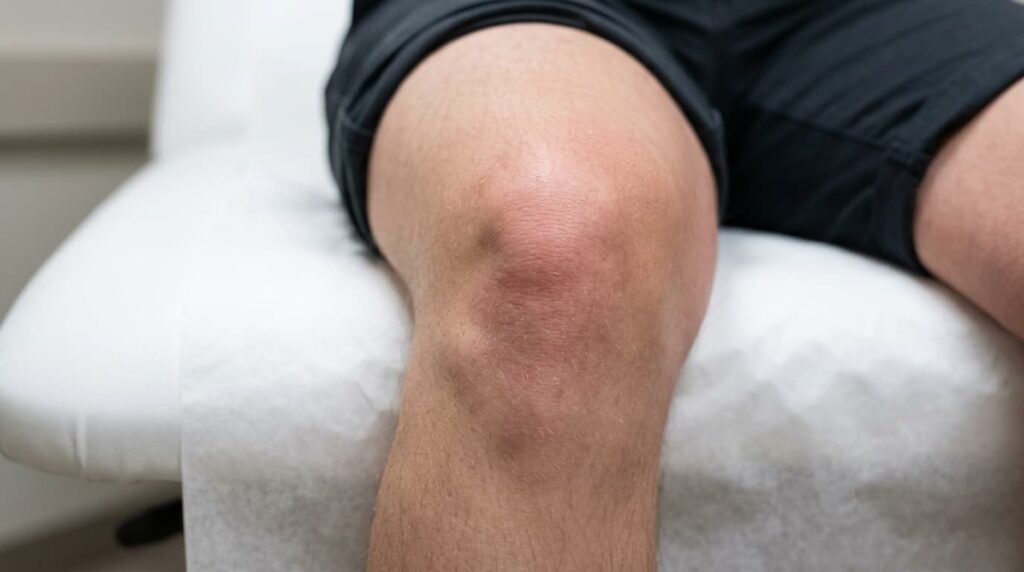
When you sit with knees bent for an extended time, the kneecap presses consistently against the same area of the femur. This sustained contact irritates the cartilage underneath and generates the dull, aching pain that people often feel after watching a film, sitting through a meeting, or travelling on a long journey.
Key contributing factors:
Weak quadriceps muscles the quads help guide the kneecap during movement; weakness leads to poor tracking Muscle imbalance between the inner and outer thigh muscles Misalignment of the kneecap, which may be structural or posture-related Overuse repetitive knee bending from running, cycling, or sitting for long stretches Previous knee injury that altered patellar alignment
PFPS is particularly common in young, active adults including runners, cyclists, and office workers who spend most of their day seated. It responds well to targeted exercise, postural correction, and activity modification when caught early.
Osteoarthritis and Knee Pain While Sitting
Osteoarthritis is a degenerative joint condition that gradually wears away the cartilage cushioning the knee. As the cartilage breaks down, the bones begin to make contact more directly, producing pain, swelling, and stiffness particularly after inactivity. This is why many people with osteoarthritis find knee pain when sitting for long periods to be one of their most consistent daily problems.
Inactivity worsens osteoarthritis symptoms in a specific way. Synovial fluid which lubricates the joint and delivers nutrients to the cartilage circulates through movement. When you sit still for an extended period, this fluid stagnates, reducing the joint’s natural cushioning and increasing stiffness. The first few steps after getting up can be uncomfortable for this reason, though movement usually helps ease the pain within a few minutes.
Common symptoms of osteoarthritis in the knee:
- Morning stiffness that eases with gentle movement
- Swelling around the joint after activity
- A grinding or crunching sensation when the knee moves
- Pain that worsens after prolonged sitting, standing, or walking
- Gradual loss of range of motion
Osteoarthritis typically develops after 50, though younger people with previous knee injuries or a history of high-impact sport can develop it earlier.
Tight Muscles and Reduced Blood Flow
When you sit for long periods, certain muscles shorten and tighten while others weaken from disuse. Tight hip flexors and quadriceps are particularly significant because they attach directly to the knee and pelvis. As these muscles contract, they pull on the structures surrounding the knee joint, altering alignment and increasing pressure on the kneecap and the tendons below it.
Tight hip flexors and knee pain while sitting are closely connected. The hip flexors cross both the hip and the knee, so prolonged sitting shortens them progressively. Over time, this tightness tilts the pelvis forward, changes the angle of the knee, and places uneven load on the joint surfaces.
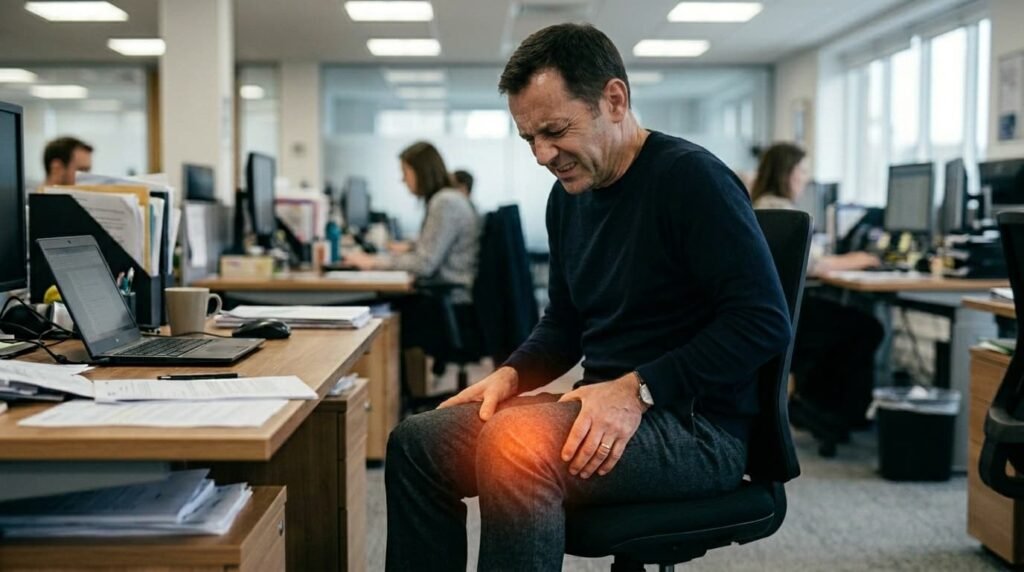
Reduced blood flow compounds the problem. When you remain still, circulation slows in the lower limbs. Oxygen and nutrients reach the knee tissues more slowly, while waste products from cellular activity accumulate in the joint space. This combination of poor circulation and muscle tightness explains why the knee can feel not just painful but heavy, numb, or swollen after sitting for too long.
Muscles most affected by prolonged sitting:
- Hip flexors — shorten and pull the pelvis and knee out of alignment
- Quadriceps — weaken, reducing their ability to absorb load at the knee
- Hamstrings — tighten, restricting the knee’s range of motion
- Glutes — weaken from disuse, transferring extra stress to the knee
- Calves — lose activation, slowing blood flow to the knee
Poor Sitting Posture and Its Effect on Knee Pain
The position you sit in has a direct effect on how much pressure your knees absorb. Sitting with legs crossed places the knee in an awkward rotated position that strains the ligaments and soft tissues on the inner and outer sides of the joint. Tucking feet under the chair or sitting with knees bent sharply past 90 degrees puts sustained pressure on the underside of the kneecap and the tendons below it.
Knee pain from sitting position is often underestimated as a cause. Many people assume their chair, desk, or sitting duration is the problem when the actual issue is how they position themselves in that chair. A chair set too low forces the knees into a sharp bend throughout the day. A chair set too high keeps the feet dangling, transferring extra weight onto the backs of the thighs and knees.
Pain in the Back of the Knee When Straightening the Leg After Sitting
Pain in the back of the knee when straightening the leg after sitting usually points to a Baker’s cyst, hamstring tendonitis, or posterior cartilage wear. A Baker’s cyst forms when excess synovial fluid pushes into the back of the knee, creating pressure or tightness when the leg straightens.
If this pain is persistent, a proper assessment is worth getting rather than assuming it is general stiffness. Specialists offering Arthrosamid injection London can assess whether a targeted treatment approach is right for you.
How to Relieve Knee Pain While Sitting
Most cases of knee pain while sitting respond well to a combination of movement habits, targeted stretching, and postural changes. The following strategies address the underlying causes rather than masking symptoms.
Take Frequent Breaks and Move Regularly
The simplest and most effective strategy is also the most overlooked: get up and move. Harvard Medical School recommends against sitting for more than six to eight hours a day and advises moving every 30 to 60 minutes if prolonged sitting is unavoidable.
When you move, the knee joint releases synovial fluid, which lubricates the cartilage and reduces friction. Even a short walk around the office, a few leg extensions while seated, or standing briefly at your desk makes a measurable difference to knee comfort over the course of a day.
Quick movement habits for desk workers:
Set a timer every 45 minutes as a reminder to stand and move Walk to a colleague rather than sending a message when possible Take phone calls standing up or while walking Do seated leg extensions straighten one leg at a time and hold for five seconds Alternate between sitting and standing if a standing desk is available
Stretch Tight Muscles to Reduce Knee Pressure
Stretching the muscles that tighten during prolonged sitting directly reduces the pull on the knee joint. Focus particularly on the quadriceps, hamstrings, hip flexors, and calves.
Effective stretches for knee pain from sitting:
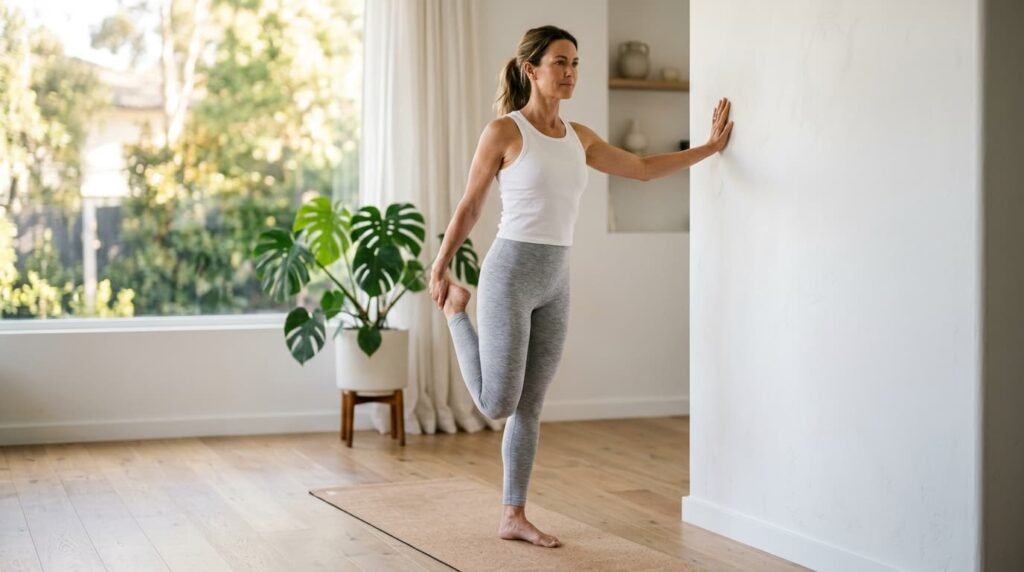
- Quad stretch — stand on one leg, pull the other heel toward the buttock, hold 20–30 seconds
- Hamstring stretch — sit at the edge of a chair, extend one leg, flex the foot, lean gently forward
- Hip flexor stretch — kneel on one knee, push hips forward until you feel a stretch at the front of the hip
- Calf stretch — face a wall, step one foot back, press the heel down, hold 20 seconds
- Seated knee bend — pull one foot toward the chair, hold briefly, release
Do two to three repetitions of each during break times throughout the day this is more effective than one long session in the evening.
Optimise Your Sitting Posture
Correcting sitting posture is one of the most impactful changes a person can make to reduce knee pain when sitting. The goal is to reduce sustained pressure on the kneecap and surrounding structures while keeping the body aligned.
Ergonomic sitting guidelines for knee health:
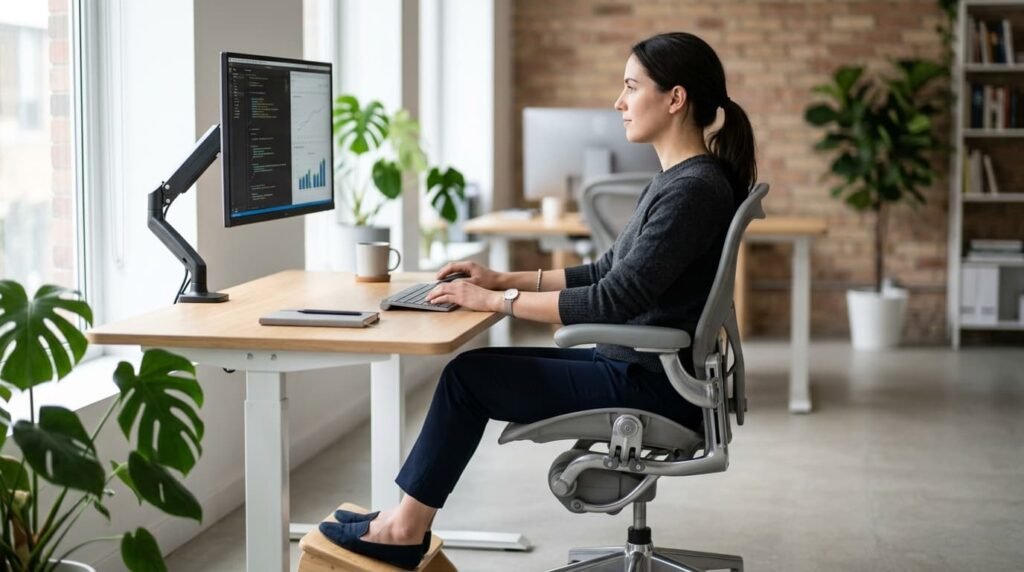
Set chair height so that feet rest flat on the floor and thighs are parallel to the ground Keep knees at approximately a 90-degree angle not sharply bent or fully extended Avoid crossing legs or tucking feet under the chair Use a footrest if the chair cannot be adjusted to a comfortable height Ensure the desk height allows clearance for knees, thighs, and feet without cramping Select an ergonomic chair with lumbar support to prevent slouching, which alters knee alignment
Apply Heat or Cold to Ease Stiffness and Pain
Heat and cold therapy are simple, accessible tools for managing knee pain while sitting. Each works differently and suits different circumstances.
Heat relaxes tight muscles and improves blood flow to the joint, making it most useful in the morning when stiffness is at its worst or after a long period of sitting. Apply a warm compress or heat pack to the knee for 15 to 20 minutes. Avoid applying heat to a swollen or inflamed joint, as this can worsen swelling.
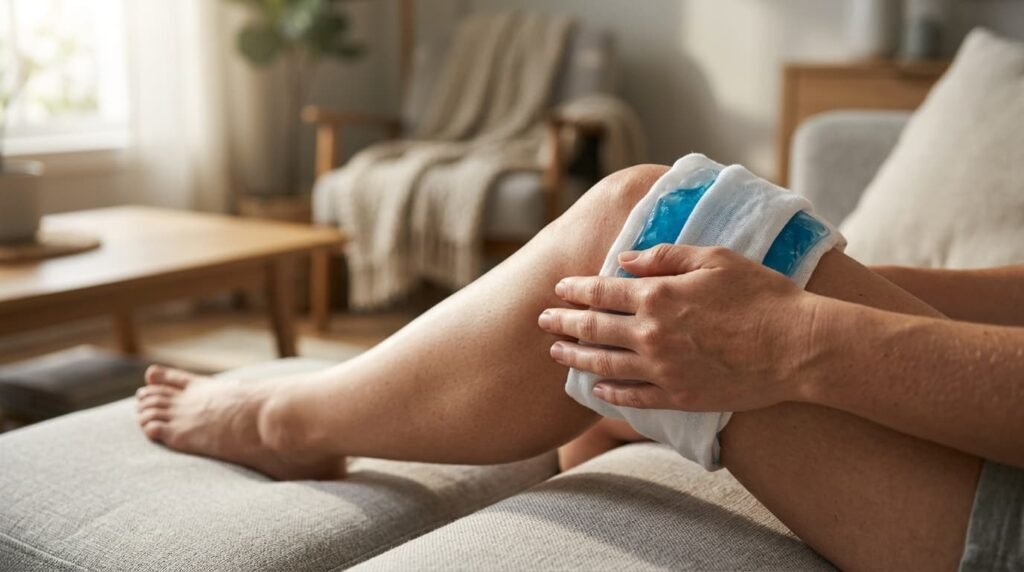
Cold therapy can reduces inflammation. Apply an ice pack wrapped in a cloth for 10 to 15 minutes after activity or when the knee feels warm and swollen. Cold is most effective in the hours after increased activity rather than during stiffness from inactivity.
When Should You Consult a Doctor for Knee Pain While Sitting?
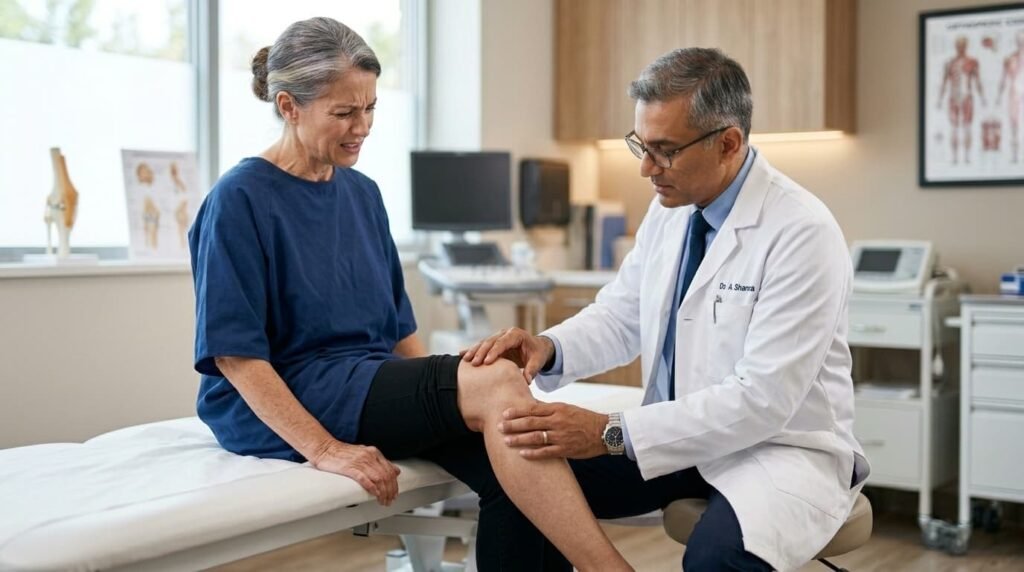
Most knee discomfort when seated improves with movement, stretching, and posture correction. But some situations require professional assessment. Waiting too long can allow the underlying condition to worsen, particularly if it involves cartilage or joint inflammation.
Severe or Persistent Pain That Does Not Improve
If knee pain while sitting has lasted more than a few weeks without improvement, or if it is getting progressively worse despite rest and postural changes, see a doctor. Persistent pain suggests an underlying condition such as osteoarthritis, a meniscus tear, or PFPS that requires diagnosis and targeted treatment.
Do not rely on over-the-counter pain relief to manage chronic knee pain long-term without understanding the cause. Pain medication reduces symptoms but does not address the reason the knee hurts. Early diagnosis of conditions like osteoarthritis allows treatment to begin before significant cartilage loss occurs.
Accompanying Symptoms That Require Attention
Certain symptoms alongside knee pain are red flags that warrant prompt medical review.
See a doctor if you experience:
- Sudden or visible swelling around the knee
- Warmth or redness — possible sign of infection or inflammatory arthritis
- Instability — a feeling the knee might give way
- Locking — the knee gets stuck in a bent or straight position
- Knee pain with fever
- Numbness or tingling in the lower leg
These symptoms alongside knee pain when sitting deserve prompt evaluation. Conditions like rheumatoid arthritis, a Baker’s cyst, or a meniscus tear often begin as sitting-related discomfort before progressing further.
Prevention Tips for Knee Pain While Sitting
Maintain an Active Lifestyle
Regular physical activity is the single most important factor in long-term knee health. Exercise strengthens the quadriceps, hamstrings, and glutes the muscles that absorb load and stabilise the knee during both movement and sitting. Stronger surrounding muscles reduce the direct pressure on the joint itself.
Low-impact activities are particularly beneficial for people who already experience knee pain after prolonged sitting. Swimming, cycling, and walking build strength and maintain flexibility without the impact forces that worsen joint irritation. Even 20 to 30 minutes of low-impact exercise three or four times a week makes a measurable difference to knee pain levels over time.
Ergonomics Matter for Knee Pain at the Desk
People in desk jobs face a specific challenge: their work requires extended sitting, but prolonged sitting is itself a significant cause of knee discomfort. Good ergonomics reduce the impact of unavoidable sitting time.
Knee pain desk job workers experience most often comes from chairs set at the wrong height, insufficient movement breaks, and poor lower-limb positioning. Setting up the workspace correctly including chair height, footrest use, monitor position, and keyboard placement reduces cumulative strain on the knee throughout the working day.
A standing desk is a worthwhile investment for those with persistent knee pain while sitting. Alternating between sitting and standing every 30 to 60 minutes keeps the joints moving, maintains better circulation, and reduces the duration of sustained kneecap pressure.
Manage Body Weight to Reduce Joint Load
Body weight has a direct mechanical impact on the knee joint. Every extra kilogram of body weight adds approximately four kilograms of additional force on the knee during normal movement. For people who are overweight, even a modest reduction in weight can produce a significant reduction in knee pain — particularly during activities that load the joint, including sitting and rising from a seated position.
A balanced diet that supports a healthy body weight, combined with regular low-impact exercise, is one of the most effective long-term strategies for reducing knee pain after prolonged sitting and preventing its recurrence.
Related Conditions: When Sitting Keeps Hurting Your Knees
The Role of Synovial Fluid in Knee Comfort
Synovial fluid is the natural lubricant of the knee joint. It reduces friction between the joint surfaces, delivers nutrients to the cartilage, and helps the knee absorb impact during movement. When the knee is kept still for a prolonged period, the circulation of synovial fluid within the joint slows significantly.
This reduction in fluid movement explains why the knee feels stiff and resistant when you first stand up after sitting. Gentle movement even straightening and bending the knee while seated encourages synovial fluid to circulate and eases that initial stiffness. In people with osteoarthritis or rheumatoid arthritis, reduced synovial fluid quality compounds the problem because the fluid itself is less effective at protecting the joint surfaces.
Aging Knee Pain and Sitting
As the body ages, the cartilage in the knee naturally loses some of its thickness and elasticity. This gradual degeneration makes the joint more sensitive to sustained pressure including the kind that comes from prolonged sitting. Aging knee pain sitting patterns typically involve stiffness that is worst in the morning or after long periods of inactivity, easing somewhat once the joint warms up with movement.
Older adults often find that knee pain while sitting becomes more pronounced in cold weather, after long car journeys, or following a particularly sedentary day. These patterns are consistent with cartilage changes associated with age and early osteoarthritis. Regular movement, appropriate exercise, and maintaining a healthy body weight all slow the rate of age-related knee degeneration significantly.
Iliotibial Band Syndrome and Outer Knee Pain
Iliotibial band (IT band) syndrome causes pain on the outer side of the knee and is most commonly associated with running. However, prolonged sitting particularly in poor posture or with the hips in a compressed position can also aggravate the IT band by keeping it under sustained tension.
If you notice a clicking sensation or sharp pain on the outside of the knee after sitting for a long time, IT band tightness may be contributing. Stretching the IT band and hip abductors, alongside correcting sitting posture, usually resolves this type of knee discomfort.
FAQ
What is the best sitting position for knee pain?
Keep knees at approximately 90 degrees with feet flat on the floor. Avoid crossing legs, tucking feet under the chair, or sitting with knees sharply bent. Set chair height so thighs are parallel to the floor and weight is evenly distributed across the seat. Use a footrest if the chair cannot be adjusted to a comfortable position.
Why do I feel pain in the back of my knee when straightening my leg after sitting?
Pain in the back of the knee when straightening the leg after sitting is most commonly caused by a Baker’s cyst, hamstring tendonitis, or cartilage irritation in the popliteal area. Each condition affects the knee differently and responds to a different course of treatment. A proper clinical assessment from a doctor or physiotherapist is the most reliable way to identify the exact cause and begin the right treatment plan.
Does aging cause knee pain when sitting?
Yes. As cartilage gradually degenerates and synovial fluid quality reduces with age, the knee becomes increasingly sensitive to sustained pressure during prolonged sitting. Stiffness after getting up from a chair is one of the earliest signs of age-related joint changes. Regular low-impact exercise, consistent movement breaks, and maintaining a healthy body weight all help slow this process significantly.
When should I see a doctor for knee pain while sitting?
See a doctor if knee pain while sitting has lasted more than two to three weeks without meaningful improvement, especially if home remedies and postural changes have not helped. Seek prompt attention if the knee is visibly swollen, warm, unstable, or locking during movement. Early diagnosis leads to better outcomes and a wider range of available treatment options.
Knee pain while sitting is rarely something you simply have to accept. In most cases, the cause is clear whether it is patellofemoral pain syndrome, osteoarthritis, tight hip flexors, or poor posture and so is the path forward.
Regular movement breaks, targeted stretching, and ergonomic adjustments help most people see real improvement within weeks. If symptoms persist or worsen, early specialist assessment protects the joint and opens up more treatment options.
For those in London seeking expert, non-surgical knee care, knee pain clinic offers specialist treatment led by Mr Syed Nadeem Abbas an orthopaedic physician with over 25 years of experience. Trusted by over 3,500 patients across the UK, the clinic specialises in the Arthrosamid hydrogel injection, a single, minimally invasive procedure delivering up to five years of knee pain relief without surgery.
Read more: Knee Arthritis Treatment Options: A Complete Guide to Managing Knee Osteoarthritis
Read more: Knee Replacement Surgery How to Know When It Is the Right Step