
Knee pain exercises for women remain one of the most searched topics in health and fitness and understandably so. Women face a significantly higher risk of knee problems than men, driven by differences in hip anatomy, hormonal fluctuations, and muscle composition. In fact, women are up to three times more likely to experience certain knee conditions. such as ACL injuries and patellofemoral pain syndrome, compared to men.
The encouraging reality is that a well-structured, consistent exercise routine can make a meaningful difference for the vast majority of women experiencing knee discomfort. Strengthening the muscles around the knee reduces pressure on the joint itself, eases existing pain, and builds long-term resilience against future injury.
Why Women Are More Likely to Experience Knee Pain
Knees do a remarkable amount of work. They carry the full weight of your body every time you stand, walk, climb stairs, or change direction. Knee pain exercise for Women, in particular, carry a heavier biomechanical burden than is often recognised.
Several factors make female knees more vulnerable. A wider pelvis creates a greater inward angle at the knee known as the Q-angle which places additional stress on the knee cap with every step. Hormonal changes, especially during pregnancy and menopause, loosen the ligaments supporting the joint and accelerate muscle loss around it. Women also tend to have less quadriceps strength relative to hamstring strength, creating muscle imbalances that destabilise the knee during movement.
The next step is moving in ways that address it.
The Best Knee Strengthening Exercises for Women
These exercises target the muscles that directly support the knee, the quadriceps, hamstrings, glutes, and hip abductors. When these muscle groups are strong, the knee joint itself absorbs far less stress during everyday activities. Aim for two to three sessions per week. If any movement produces sharp or worsening pain, stop immediately and consult a physiotherapist.
1. Glute Bridge Exercise for Knee Pain Relief
The glute bridge is one of the most effective exercises for knee pain because it simultaneously engages the glutes and hamstrings two muscle groups that play a central role in knee stability. Weak glutes are a surprisingly common contributor to knee problems, particularly in women who spend long hours seated.
Lie on your back with your knees bent and feet flat on the floor, roughly hip-width apart. Press firmly through your feet and lift your hips until your body forms a straight line from shoulders to knees. Hold for two seconds at the top, then lower with control.
Once this feels comfortable, place a resistance band just above the knees to engage the hip abductors as well. This small addition significantly increases the exercise’s benefit for knee stability.
2. Clamshell Exercise for Knee and Hip Support
The clamshell exercise for knees targets the hip abductors and external rotators, the muscles responsible for preventing the knee from collapsing inward during movement. This inward collapse, sometimes called knee valgus, is one of the most common patterns underlying knee pain in women.
Lie on your side with your hips stacked and knees bent at roughly forty-five degrees. Keeping your feet together, lift your top knee as high as you can without allowing your pelvis to rotate. Complete fifteen to twenty repetitions on each side for two to three sets.
3. Quad Strengthening Exercises: Straight Leg Raise
Quad strengthening exercises form the backbone of almost every knee rehabilitation programme, and for good reason. Weak quadriceps place excessive strain directly on the kneecap, worsening pain over time. The straight leg raise builds quad strength without requiring the knee to bend under load, making it particularly well-suited for women managing existing discomfort.
Lie flat on your back. Bend one knee with your foot resting flat on the floor, and keep the other leg straight. Tighten the thigh muscle of the straight leg, then lift it to approximately forty-five degrees. Perform three sets of ten to fifteen repetitions per leg.
Once this feels manageable, an ankle weight can be added to continue building strength progressively.
4. Hip Strengthening for Knee Pain: Side-Lying Leg Lift
Hip strengthening for knee pain is one of the most clinically supported and most overlooked approaches available. Research has consistently shown that women with kneecap pain who incorporate hip strengthening into their routine experience significantly greater relief than those who focus on knee exercises alone.
Bend the bottom knee slightly for stability, and keep your top leg straight with toes pointing forward. Lift the top leg to approximately forty-five degrees, pause briefly, then lower with control. Repeat fifteen times on each side for two to three sets.
The movement is simple and requires no equipment, yet its impact on knee pain is well documented. A resistance band above the ankle increases the load as strength develops.
5. Wall Squat — Low Impact Knee Exercise with High Returns
Wall squats are among the most practical low impact knee exercises for women because they build quad and glute strength while significantly reducing the load on the joint. The wall acts as a support structure, allowing you to control the depth of movement and limit strain on sensitive tissue.
Stand with your back flat against a wall, feet shoulder-width apart and positioned roughly thirty centimetres from the wall. Slide your back down until your thighs are approximately parallel to the floor. Hold the position for twenty to thirty seconds, working towards sixty seconds over time. Rest for thirty seconds between sets, completing three rounds in total.
6. Step-Up Exercise for Knee Stability
Step-ups replicate the movements your knees encounter throughout the day stairs, kerbs, vehicle entry, and changes in surface height.
Stand in front of a step or a sturdy low platform approximately fifteen to twenty centimetres in height. Step up with your right foot, pressing through your heel to straighten your knee fully. Bring your left foot up to meet it, then step back down in a controlled manner. Alternate the leading leg for three sets of ten repetitions per side.
As strength and confidence increase, raise the step height or incorporate light hand weights to continue challenging the muscles.
Knee Stretches for Women at Home
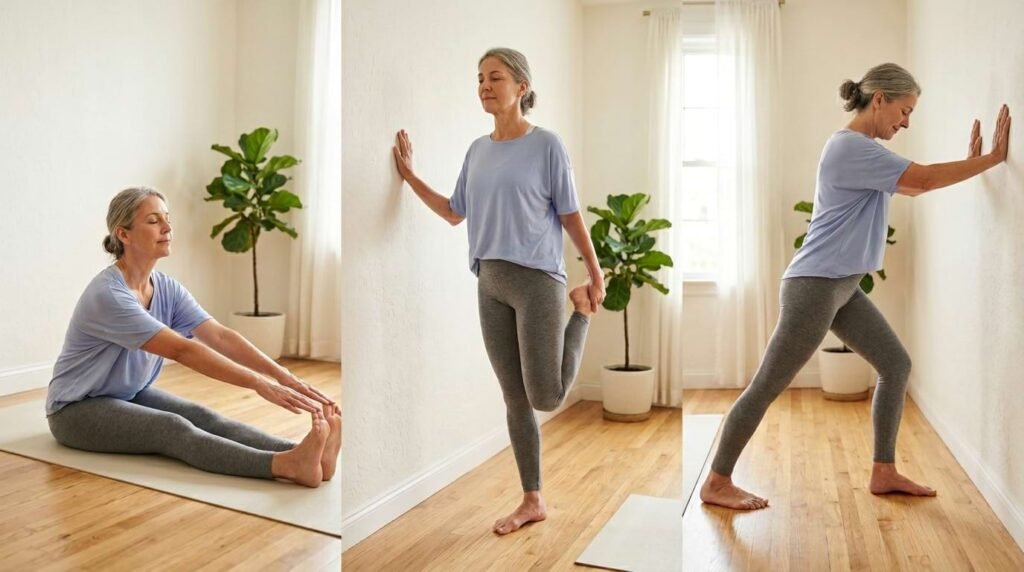
Strengthening is only half of the equation. Tight muscles, particularly the hamstrings, quadriceps, and calves exert pulling forces on the knee joint that increase pain and restrict movement. These knee stretches for women at home require no equipment and can be completed in under ten minutes.
Hamstring Stretch
Sit tall, then gently reach forward towards your toes while keeping your back as straight as possible. Hold for twenty to thirty seconds, breathing steadily, and repeat two to three times.
Reaching your toes is not the goal. A gentle pulling sensation behind the thighs is sufficient. Forcing the stretch through a rounded back reduces its effectiveness and risks injury.
Standing Quad Stretch
Stand near a wall or sturdy chair for balance support. Bend one knee and bring your foot towards your glutes, holding your ankle with the same-side hand. Keep your knees close together and stand tall without allowing your hips to push forward. Hold for twenty to thirty seconds on each side, repeating two to three times.
Chronically tight quadriceps pull the kneecap upward and out of proper alignment, contributing to pain along and beneath the kneecap. Regular stretching helps restore the balance between quad tension and kneecap position.
Standing Calf Stretch
Stand facing a wall with your hands resting against it at chest height. Step one foot back, keeping it flat on the floor with the heel pressed firmly down. Lean gently into the wall until a stretch is felt along the back of the lower leg. Hold for twenty to thirty seconds on each side and repeat two to three times.
Tight calf muscles restrict ankle mobility, which in turn causes the knee to compensate with altered movement patterns. Addressing calf tightness is a simple but effective part of any knee pain routine.
Exercises for Specific Knee Conditions
Different knee conditions respond to different approaches. Knowing which exercises suit your specific situation helps you recover faster and avoid movements that could make things worse.
Patellofemoral Pain Syndrome Exercises
Patellofemoral pain syndrome (PFPS) — commonly referred to as runner’s knee causes pain around or beneath the kneecap. It affects women at higher rates than men, largely due to the wider Q-angle and the associated inward tracking of the kneecap during movement.
What to Do
The most effective patellofemoral pain syndrome exercises combine hip strengthening with controlled quad work. Clamshells correct inward knee collapse, straight leg raises build quad strength without loading the joint, and short arc quads lying on your back with a rolled towel under the knee and straightening the leg against it for five seconds activate the inner quad muscle that controls kneecap tracking. Stationary cycling and swimming are both gentle on the kneecap and suitable for cardiovascular activity.
What to Avoid
Deep squats and full lunges should be avoided during a flare-up, as they concentrate pressure directly onto an already irritated kneecap. Once symptoms settle, reintroducing these movements gradually is appropriate.
Knee Exercises for Osteoarthritis in Women
Osteoarthritis affects women at substantially higher rates than men, with incidence rising sharply after menopause. Despite the instinct to rest, inactivity weakens the surrounding muscles and increases pain over time.
Best Exercises to Try
The best knee exercises for osteoarthritis in women focus on gentle mobility and low-impact activation heel slides, seated knee extensions, stationary cycling, and water exercise, which reduces joint load by up to seventy-five percent. Consult your GP or physiotherapist before beginning if you have a confirmed diagnosis.
How to Prevent Knee Pain in Women Long-Term
Exercise is the foundation, but sustainable knee health depends on broader daily habits.
Manage your weight
Every kilogram of excess body weight adds approximately four kilograms of pressure through the knee joint. Even modest weight loss produces a noticeable reduction in pain.
Choose the right footwear
High heels shift body weight forward onto the kneecap. Flat, supportive shoes distribute load more evenly and reduce cumulative joint stress.
Warm up and cool down
Cold muscles are more vulnerable to strain and take longer to recover. A few minutes of gentle movement before and after exercise protects the surrounding tissues.
Strengthen your core and vary your activity
A strong core improves lower-limb alignment, reducing the forces passing through the knee. Mixing walking, cycling, and swimming prevents the repetitive wear that accelerates cartilage breakdown.
Know when to stop
Mild muscle fatigue during exercise is normal. Sharp, stabbing, or rapidly worsening pain is not a signal to rest and reassess.
When to See a Doctor — and What Treatment May Involve
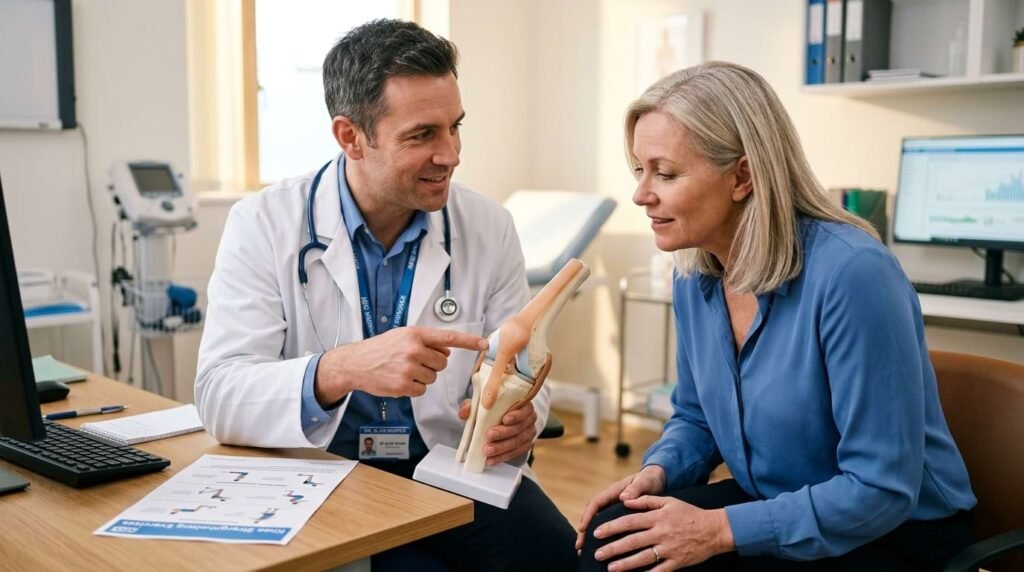
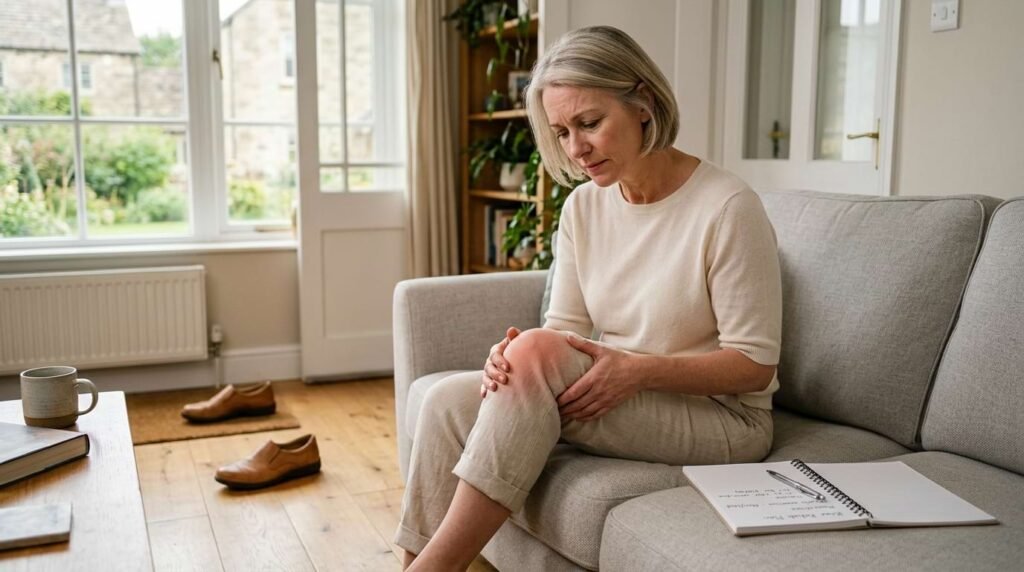
See a doctor if pain is severe, the knee is swollen or unstable, or a sudden injury involves a pop or giving way.
Treatment Options
A physiotherapist can build a personalised plan, while a specialist may recommend imaging. For persistent inflammation or osteoarthritis, options include corticosteroid injections for short-term relief, hyaluronic acid injections to lubricate the joint, and Arthrosamid a polyacrylamide hydrogel injection that integrates into joint tissue and provides longer-lasting cushioning, with some women reporting relief for two or more years. All treatments work best alongside exercise, not instead of it.
FAQ
How long does it take for knee strengthening exercises to show results?
Most women notice a meaningful reduction in discomfort within four to six weeks of exercising consistently three times per week. Significant strength gains typically take eight to twelve weeks to develop. The key variable is consistency; sporadic effort produces unpredictable results. Tracking sessions in a simple diary or app can help maintain accountability during this period.
Can I do knee exercises every day?
Light mobility work such as hamstring stretches, calf stretches, and heel slides can be performed daily without concern. Strengthening exercises, however, require twenty-four to forty-eight hours of recovery between sessions to allow muscle fibres to repair and adapt. Training strength exercises daily without adequate rest can irritate the joint rather than protect it.
Is the glute bridge safe during a knee pain flare-up?
Generally, yes. The glute bridge exercise for knee pain is one of the most rehabilitation-friendly options during a flare-up because it works the posterior chain without placing any load through a bent knee. Stop the movement if it produces sharp discomfort, and seek physiotherapy guidance if pain persists beyond a few days.
What footwear is best for women with knee pain?
Flat, well-cushioned shoes with adequate arch support are the safest choice for day-to-day use. High heels shift the body’s centre of gravity forward, compressing the kneecap and increasing joint pressure with every step.
Can Water Exercise Really Help Women with Knee Osteoarthritis?
Water-based exercise is one of the most consistently recommended options for knee exercises targeting osteoarthritis in women. Buoyancy reduces the load on the joint by up to seventy-five percent, allowing a full range of motion without the pain that often accompanies land-based activity.

Knee pain does not have to be a permanent feature of life. With the right exercises and the commitment to repeat them, most women can reduce discomfort substantially, rebuild meaningful strength, and return to the activities they value.
Start with two or three movements from this guide. Build gradually over several weeks. Listen carefully to the signals your body sends and improvement should feel progressive, not punishing. If pain worsens or fails to improve after six weeks of consistent effort, speaking with a physiotherapist or GP is a sensible next step.
Read more: Menopause and Knee Pain: Why It Happens and How to Manage It
Read more: How Vitamins and Joint Pain Are Connected: A Complete Guide


