How Ultrasound-Guided Knee Injections Improve Pain Relief

Ultrasound guided knee injection is not simply a more technical version of a standard knee injection. It is a fundamentally different procedure, one where the clinician watches the needle travel to its target in real time, confirms placement before releasing the medication, and avoids the structures that should not be touched.The difference between guided and unguided injection is not marginal. It is the difference between a treatment that works and one that misses its target entirely.
What is ultrasound guided knee injection?
Ultrasound guided knee injection uses real-time imaging to direct a needle precisely into the knee joint or surrounding soft tissue. A radiologist or trained clinician places a small probe against the skin, which shows a live picture of the joint structures on a screen. This lets them watch the needle travel exactly where it needs to go.
Compare that with a blind injection knee procedure, where the clinician relies purely on anatomical landmarks and feel. Research backs up why guidance matters here. Studies have found ultrasound guided knee injections achieve accuracy rates above 95% across all approaches, while blind injections range from roughly 77% to 96% depending on technique. One systematic review of randomised trials went further: ultrasound guided injections outperformed blind injections in every single study reviewed, with the superolateral approach combined with quadriceps contraction proving most reliable.
That gap in blind vs ultrasound guided injection accuracy isn’t just academic. Missing the joint space means the medication ends up in muscle or fat tissue instead of where it’s needed, which can mean a wasted appointment and continued pain.
Why ultrasound guided injection accuracy matters for knee pain injections
Knee pain injections only work if the medication reaches the right spot. Whether the treatment is a corticosteroid injection knee treatment for arthritis flare-ups or hyaluronic acid knee injection therapy for lubrication, ultrasound guided injection accuracy directly affects the results.
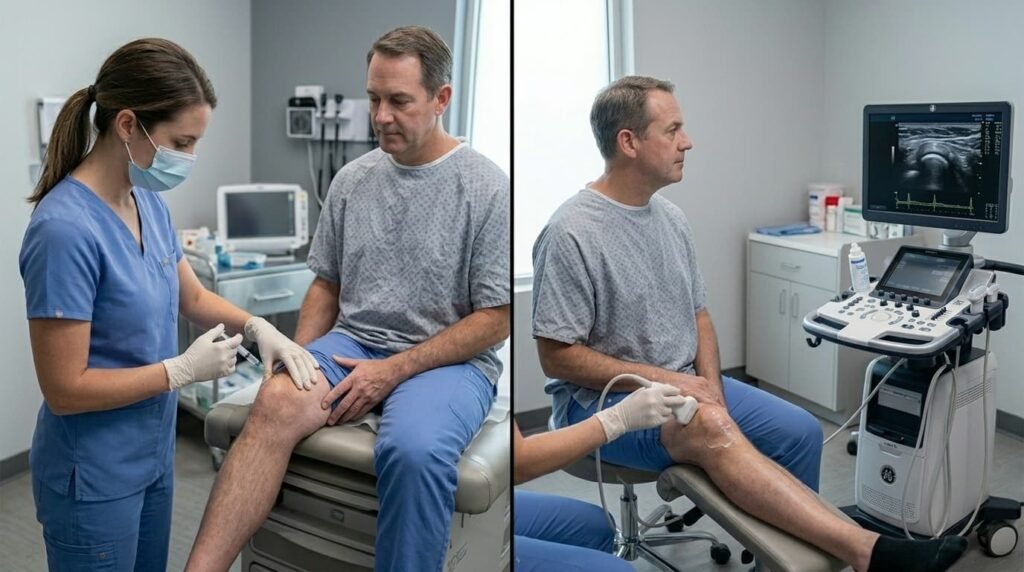
A randomised study comparing expert and inexperienced clinicians found something telling. Among expert physicians, there was little difference between blind and ultrasound guided accuracy, but among less experienced clinicians, failure rates with blind injection reached 21%, compared to just 6% under ultrasound guidance. In plain terms: ultrasound levels the playing field, so the experience of the clinician matters less when imaging confirms placement.
Another trial focusing specifically on the suprapatellar approach found a similar pattern. Ultrasound guided hyaluronic acid injections reached the joint space successfully in 96% of cases, compared with 83.7% for blind injections. That difference can mean the gap between real relief and a follow-up appointment.
Common conditions treated with knee injection treatment
Knee osteoarthritis injection
Knee osteoarthritis injection is probably the most frequent reason people search for this treatment. As cartilage wears down, the joint becomes inflamed, stiff and painful. A steroid injection knee procedure can calm that inflammation fast, often within a few days.
Baker’s cyst injection and treatment
A Baker’s cyst forms when fluid builds up behind the knee, often linked to underlying arthritis or a meniscal tear. Baker’s cyst treatment usually starts with draining the fluid, then a Baker’s cyst injection of steroid to reduce the chance of it refilling. Doing this under ultrasound means the clinician can see the cyst clearly and avoid nearby blood vessels and nerves.
Runner’s knee injection and IT band syndrome
Runner’s knee injection approaches target pain around the patella, often caused by IT band syndrome knee injection candidates dealing with iliotibial band friction syndrome treatment needs. This band of tissue runs along the outer thigh and can become tight and inflamed with repetitive movement, which is why distance runners and cyclists see this condition often.
Prepatellar bursitis (housemaid’s knee) injection
Prepatellar bursitis injection, sometimes nicknamed housemaid’s knee injection, addresses swelling in the small fluid sac at the front of the kneecap. It’s common in people who kneel for extended periods at work, such as carpet fitters or gardeners.
Patella tendinopathy and jumper’s knee treatment
Patella tendinopathy injection options help athletes dealing with jumper’s knee treatment needs, where the tendon connecting the kneecap to the shin becomes irritated from repetitive jumping or sprinting.
Fat pad impingement and Hoffa’s fat pad treatment
Fat pad impingement injection, also called Hoffa’s fat pad impingement treatment, targets a cushion of fatty tissue just below the kneecap that can become pinched and inflamed, often after a twisting injury.
Pes anserine bursitis injection
Pes anserine bursitis injection treats inflammation where three tendons meet on the inner side of the knee, just below the joint. Pes anserine tendinopathy treatment is frequently confused with arthritis pain since both sit in a similar location, which is exactly why an accurate ultrasound diagnosis matters before treatment begins.
Types of knee injection for pain: steroid, PRP, hyaluronic acid and Arthrosamid
Corticosteroid injection knee
A corticosteroid injection knee treatment reduces inflammation quickly and remains one of the most widely used options for arthritis flare-ups. Knee steroid injection side effects are generally mild, though some people experience a short-term steroid flare after knee injection, where pain temporarily worsens for a day or two before easing.
Hyaluronic acid knee injection
Hyaluronic acid knee injection therapy works differently. Rather than reducing inflammation, it supplements the joint’s natural lubricating fluid, which can ease friction in arthritic knees. Hyaluronic acid injection vs steroid knee comparisons usually come down to timing: steroids act faster, hyaluronic acid lasts longer for some patients.
PRP injection knee
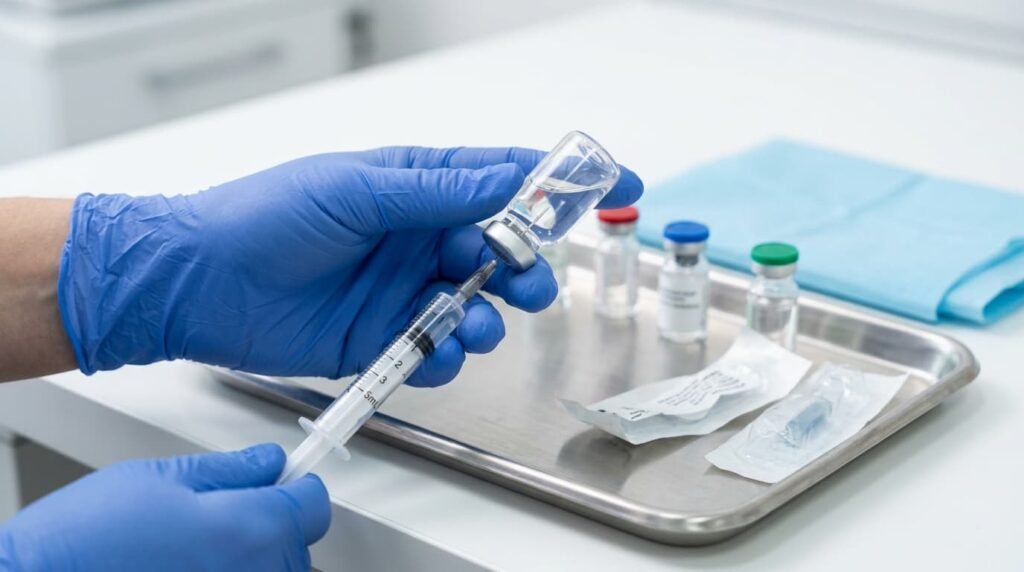
PRP injection knee treatment uses the patient’s own blood, processed to concentrate platelets, which are then injected to encourage tissue repair. PRP vs steroid injection knee studies suggest PRP may offer longer-lasting benefits for certain osteoarthritis cases, though results vary between individuals.
Arthrosamid injection knee
Arthrosamid injection knee treatment is one of the newer options gaining attention in the UK. Unlike traditional fillers, Arthrosamid is a non-degradable hydrogel designed to stay in the joint long-term rather than being absorbed by the body over weeks or months. This means a single Arthrosamid knee injection may continue cushioning the joint well beyond the typical six-month window many patients get from steroid injection knee or hyaluronic acid knee injection treatments. Many clinics now offer it as private knee injection London patients consider when they want a longer interval between treatments and fewer repeat visits.
What to expect: knee injection procedure and recovery time
Before your appointment
Patients typically have a brief consultation where the clinician reviews their knee injection treatment history and confirms which type of injection suits their condition. For those considering ultrasound guided steroid injection or ultrasound guided injection knee pain treatment for the first time, the radiologist will explain exactly what they’re looking at on screen.
During the knee injection procedure
The knee injection procedure itself usually takes 15 to 20 minutes. The patient lies down, the area gets cleaned, and the ultrasound probe maps out the exact injection site before the needle goes in.

Are knee injections painful?
Are knee injections painful is one of the most common questions patients ask before their first appointment. Most people describe a brief sting or pressure rather than significant pain, and a local anaesthetic is often used alongside the main injection to keep things comfortable.
Knee injection recovery time
Knee injection recovery time is generally short. Most people can walk normally straight away, though strenuous activity is best avoided for 24 to 48 hours. Can patients drive after a knee injection? In most cases, yes, since these procedures don’t require sedation, though it’s worth checking with the clinician on the day.
Knee injection side effects and safety considerations
Knee injection side effects are usually mild and short-lived. Common reactions include brief swelling, a feeling of warmth, or a short flare in pain before improvement kicks in. Knee injection infection risk is low, particularly with ultrasound guidance, since the clinician can confirm a clean path away from blood vessels.
How many knee injections can a patient have? Most clinicians limit steroid injections to three or four per year in the same joint to protect cartilage health. How many steroid injections a patient can have in their knee depends on their specific condition, response to previous treatments, and overall joint health, so this is always discussed case by case.
How long does a knee injection last?
How long a knee injection lasts varies by type. Steroid injection knee how long to work is typically two to three days, with relief lasting anywhere from six weeks to several months. How long does a steroid injection last in the knee depends on the severity of underlying arthritis. Hyaluronic acid tends to last four to six months, while Arthrosamid is designed for much longer durability given its non-absorbable formulation.
Knee injection cost UK and where to get treatment
Knee injection cost UK prices vary depending on whether treatment is sought through the NHS or a private knee injection London clinic. Private clinics often provide same-week appointments and the option to choose ultrasound guided steroid injection or newer treatments like Arthrosamid, which may not yet be widely available through standard NHS pathways. For ongoing joint health beyond injections, the guide on managing daily knee pain offers practical home strategies that complement clinical treatment.
Non-surgical knee pain treatment: when injections make sense
Non-surgical knee pain treatment options, including ultrasound guided knee injection, are usually tried before surgery is considered. For those earlier in their treatment journey, the article comparing arthritis and general joint pain explains how to recognise which condition is actually present, which helps determine the best injection type for knee pain. For those managing long-term arthritis, the piece on osteoarthritis management covers complementary approaches alongside injection therapy.
How these related treatments connect to ultrasound guided knee injection
Each condition and injection type discussed above ties back to the same core idea: precision matters. Knee osteoarthritis injection, Baker’s cyst treatment, runner’s knee injection, prepatellar bursitis injection, patella tendinopathy injection, and pes anserine bursitis injection all involve delicate anatomical targets close to nerves, blood vessels, or thin soft tissue structures. Steroid injection knee, hyaluronic acid knee injection, PRP injection knee and Arthrosamid injection knee are simply different medications, but all of them depend on accurate placement to work.
Frequently asked questions
Is ultrasound guided knee injection better than a blind injection?
Yes. Ultrasound guided injection accuracy consistently outperforms blind techniques, particularly when the clinician has less experience. Across every anatomical injection site studied, ultrasound guided injections were more accurate than blind injections.
Are knee injections painful?
Most patients report mild discomfort rather than significant pain, especially when local anaesthetic is used alongside the main injection.
How long does a knee injection last?
This depends on the type. Steroid injections typically last six weeks to a few months, hyaluronic acid injections four to six months, and Arthrosamid is designed to last considerably longer due to its non-absorbable structure.
What’s the knee injection cost UK patients can expect privately?
Private knee injection London clinics vary in pricing depending on injection type, with newer treatments like Arthrosamid often priced higher than standard steroid injection knee options.
Can patients drive after a knee injection?
Generally yes, since no sedation is involved, though always confirm with the clinician beforehand.
How many knee injections can a patient have in a year?
Most clinicians cap steroid injections at three to four per year per joint to avoid cartilage damage, though this varies by individual case and condition severity.
Ultrasound guided knee injection represents the current standard of care for a reason. Accuracy rates consistently exceed those of blind injection techniques across every anatomical approach studied, and the gap is most significant precisely where it matters most: in less experienced hands, in difficult anatomy, and in patients who cannot afford another failed appointment.

The conditions treated, the medications used, and the outcomes achieved all depend on one foundational requirement: the needle reaching the right structure. Ultrasound guidance fulfils that requirement reliably, reproducibly, and with a safety profile that blind injection cannot match.
For patients in the UK weighing their options, whether that means a corticosteroid injection for an acute flare, hyaluronic acid for lubrication, PRP for regenerative support, or Arthrosamid for sustained long-term cushioning, the clinical case for ultrasound guidance is not a preference. It is the evidence.
Read more: Knee Brace for Osteoarthritis Find the Right Type for Lasting Pain Relief
Read more: Knee Pain in Women Is Not the Same as Knee Pain in Men