
Knee pain in women is far more common than most people realise — and far more complex than a simple wear-and-tear story. Women are disproportionately affected by a range of knee conditions, and the reasons go well beyond age or activity level. Hormonal biology, anatomy, life stages, and metabolic factors all contribute to a pattern distinctly different from what men typically experience.
Yet despite this disproportionate burden, knee symptoms in women are consistently under-investigated — attributed to stress, referred later, and diagnosed less thoroughly. The result is avoidable joint damage and years of pain that could have been addressed sooner.
Hormonal biology, anatomy, life stage, and metabolic health all shape how knee conditions develop and progress in women. Understanding that picture is the starting point for managing it effectively.
Why Women Experience More Knee Pain Than Men
Women are not simply smaller versions of men with the same joint problems presenting more frequently. The causes of knee pain in women are often structurally and hormonally distinct — and understanding those differences is the starting point for effective management.
The Anatomical Differences That Change Everything
The wider female pelvis creates a greater angle between the hip and the knee — the Q angle. This increased angle alters how the quadriceps pull on the patella, predisposing women to lateral kneecap tracking problems, patellofemoral pain, and anterior knee pain at significantly higher rates than men.
Women also tend to have a narrower intercondylar notch — the groove through which the ACL passes. A narrower notch places the ligament under greater stress during pivoting and landing. This is one reason ACL injury in women occurs at four to six times the rate seen in men in equivalent sport.
Hormonal Influences on Joint Health
Oestrogen receptors exist in cartilage, synovial tissue, and the joint lining. The relationship between knee pain and oestrogen levels is therefore biological, not coincidental. This hormonal influence plays out across the female lifespan — through the menstrual cycle, pregnancy, the postpartum period, and most significantly at menopause. Each transition alters the joint environment in ways that directly affect pain and stability.
Oestrogen and Cartilage Protection
Oestrogen does more than regulate the reproductive cycle. Inside the knee joint, it actively supports cartilage health in ways that only become fully apparent when that protection is withdrawn.
Chondrocytes — the cells responsible for maintaining cartilage matrix — carry oestrogen receptors. When oestrogen levels are adequate, these cells produce the proteoglycans and collagen that give cartilage its compressive strength and resilience. When oestrogen declines, chondrocyte function deteriorates. Proteoglycan production falls. The cartilage matrix thins and becomes more vulnerable to mechanical damage.
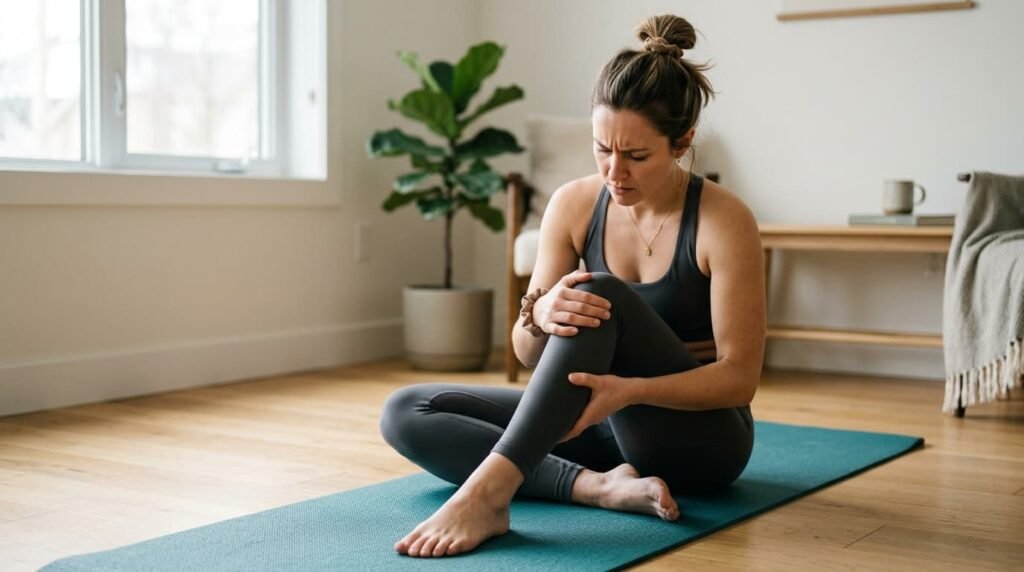
Oestrogen also moderates the production of inflammatory cytokines within the joint. Without this regulatory effect, the synovium becomes more reactive — producing higher levels of interleukin-1 and tumour necrosis factor-alpha, both of which accelerate cartilage breakdown. This is why knee osteoarthritis in post-menopausal women progresses more rapidly than in pre-menopausal women of equivalent age and activity level.
The clinical implication is significant. A woman managing knee OA symptoms adequately at 48 may find those same symptoms worsening noticeably at 52 — not because the mechanical state of the joint changed dramatically, but because the hormonal environment supporting it did. Recognising this pattern helps both patients and clinicians understand why post-menopausal knee pain is not simply a continuation of the same condition at the same rate.
Common Causes of Knee Pain in Women by Life Stage
Knee joint pain in women presents differently depending on age, activity level, and hormonal status. The causes are not uniform across the lifespan.
Knee Pain in Young Women — 20s and 30s
Knee pain in the 20s female population is frequently dismissed or underinvestigated. Several clinically significant conditions disproportionately affect this age group.
Patellofemoral pain syndrome is among the most prevalent causes. The wider Q angle, combined with muscle imbalances, causes the kneecap to track laterally rather than centrally. Pain develops at the front of the knee and worsens with stairs, squatting, and prolonged sitting. Chondromalacia patella — softening of the cartilage beneath the kneecap — often develops as an unmanaged consequence.
Hypermobility knee pain in women is widely under-recognised. Oestrogen increases ligament extensibility, and in hypermobile individuals this predisposes the knee to instability, repeated microtrauma, and chronic pain that does not present clearly on standard imaging.
PCOS knee pain is an emerging clinical consideration. Polycystic ovary syndrome is associated with chronic low-grade inflammation, insulin resistance, and visceral fat accumulation — all of which drive joint inflammation independently of mechanical load.
ACL injury in women peaks in the late teenage years and 20s. Research into ACL injury and women’s hormones has grown considerably — the mid-cycle oestrogen peak appears to affect ligament laxity and injury risk — though this has not yet translated into widespread clinical practice. Knee pain in female athletes is similarly concentrated in this age group, with IT band syndrome and patellofemoral conditions predominating in runners and team sport players.
Knee pain in women in their 30s often represents a transition period. Activity-related causes remain prominent, while the first signs of hormonal influence on joint health begin to emerge.
Knee Pain During and After Pregnancy
Knee pain during pregnancy is driven by multiple overlapping factors. Relaxin increases systemic ligament laxity from early pregnancy. Additional mechanical load, altered gait, and postural changes as the pregnancy progresses place the knee under sustained stress in a structurally less stable environment.
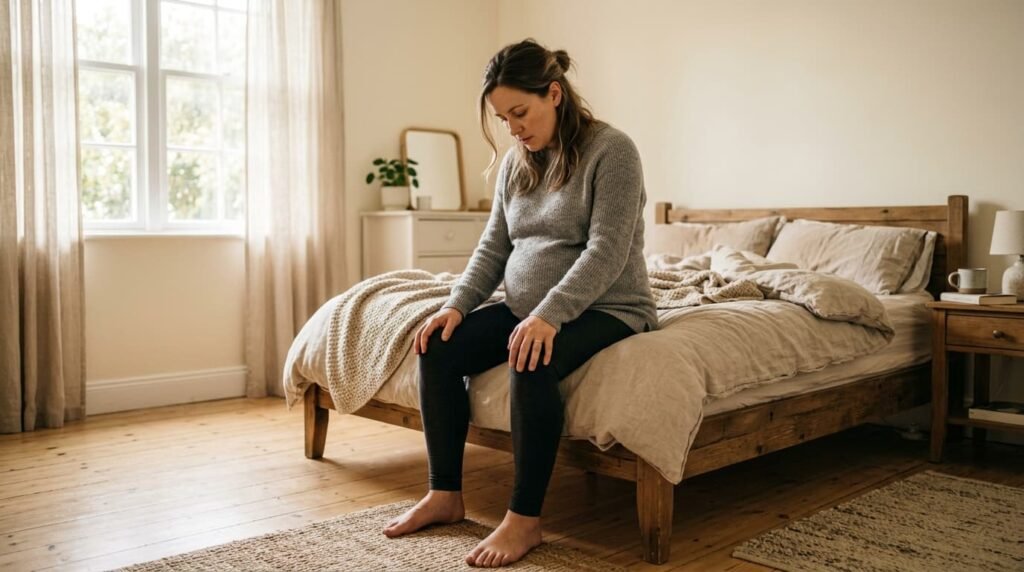
Knee pain postpartum is more common than widely acknowledged. Pain while breastfeeding occurs because relaxin levels remain elevated in some women for several months after delivery — particularly those breastfeeding exclusively. Knee pain after pregnancy that persists beyond six to eight weeks warrants clinical assessment rather than the expectation of spontaneous resolution.
Knee Pain in Women Over 40 — Perimenopause and Beyond
Joint pain in women over 40 is often where multiple risk factors converge simultaneously. Oestrogen decline removes the joint’s hormonal protection. Post-menopausal weight gain distributes preferentially as visceral fat, producing pro-inflammatory cytokines that drive synovial inflammation directly. And the cumulative load of prior activity begins to show structurally.
Knee osteoarthritis in women over 40 is the single most common cause of significant, persistent knee pain in this demographic. Knee pain at menopause is not simply age-related — it represents the intersection of mechanical and biochemical deterioration that accelerates when oestrogen is withdrawn.
Rheumatoid arthritis affects women at approximately three times the rate of men. It is an autoimmune condition driving chronic joint inflammation, typically presenting with bilateral symptoms, prolonged morning stiffness, and systemic features including fatigue. It requires specialist diagnosis and management distinct from mechanical osteoarthritis.
Meniscus tears in the over-40 group often occur without a clear injury event. Degenerative meniscal tears develop as tissue becomes less resilient with age. Knee bursitis — localised swelling and point tenderness from bursal inflammation — can develop as a secondary feature of underlying arthritis or from repetitive loading.
The Gender Bias Problem in Knee Pain Diagnosis
Why do women get more knee pain than men — and why does it take longer to diagnose? The answer involves both biology and clinical culture.
Research has consistently shown that women’s pain reports are more frequently attributed to psychological factors and less likely to result in imaging or specialist referral compared to equivalent presentations in men. Young women with knee pain are particularly affected — their symptoms are more likely to be normalised or dismissed with advice to rest.
The consequences are real. Patellofemoral syndrome progresses to cartilage damage. Hypermobility-related instability leads to cumulative soft tissue injury. Inadequately managed ACL tears increase the risk of early-onset osteoarthritis. The cost of dismissing knee pain in women is measured in joint health across decades.
Treatment and Management Options
Conservative management is the appropriate starting point for most causes of knee pain in females — structured physiotherapy targeting the specific mechanical problem, not generic rest.
When Conservative Management Is Not Enough
For women with knee osteoarthritis, rheumatoid arthritis, or conditions not responding to physiotherapy, a broader range of treatment options is available.
Injection therapy now extends well beyond corticosteroid injections, which provide only short-term relief and carry cartilage risks with repeated use. Hyaluronic acid injections offer improved lubrication for six to eight months. Arthrosamid — a permanent hydrogel implant — integrates into the synovial lining and can provide sustained relief for up to three to four years from a single procedure. This is particularly relevant for women managing moderate to severe osteoarthritis who are not yet ready for surgical intervention.
Getting the Right Assessment
For women searching for knee pain women private specialist London, direct access to an orthopaedic specialist provides a far more thorough assessment than the standard GP pathway — including imaging review, a physical examination of joint mechanics, and a management plan addressing the specific cause rather than the presenting symptom.
FAQ
Why is knee pain more common in women than men?
Anatomical differences — including a wider Q angle and narrower intercondylar notch — combined with hormonal influences on cartilage, ligament laxity, and joint inflammation create a distinct risk profile for knee pain in females compared to men.
What causes knee pain in young women specifically?
Patellofemoral pain syndrome, hypermobility, PCOS-related inflammation, and ACL injury are the most common causes in women aged 20 to 40. These conditions are often under-investigated in this age group despite being clinically significant.
Why does knee pain get worse around menopause?
Oestrogen withdrawal removes the hormonal protection of joint cartilage. Post-menopausal weight gain adds visceral fat-driven inflammation. Both processes accelerate cartilage breakdown simultaneously.
Can pregnancy cause lasting knee damage?
Knee pain during pregnancy is typically driven by relaxin-related laxity and mechanical load. In most cases it resolves postpartum as hormone levels normalise. Where it persists beyond two to three months after delivery, assessment is recommended to rule out structural causes.
When should a woman with knee pain see a private specialist?
When pain has persisted for more than six to eight weeks, is worsening despite conservative management, significantly limits daily activity, or has been inadequately investigated through the standard NHS pathway — a private specialist consultation provides the most direct route to accurate diagnosis and appropriate treatment.
Does PCOS affect the knees?
PCOS-related knee pain is associated with chronic low-grade inflammation, insulin resistance, and weight distribution changes common to the condition. Women with PCOS may experience joint inflammation disproportionate to any structural findings.
Knee pain in women is not a single condition with a single cause. It is a spectrum shaped by anatomy, hormones, life stage, activity level, and metabolic health — and it deserves clinical assessment that accounts for all of those dimensions.

From patellofemoral syndrome in a 25-year-old athlete to accelerating osteoarthritis in a 55-year-old post-menopausal patient, the causes are distinct enough to require distinct management approaches. Getting that right starts with accurate diagnosis — and that requires a specialist who understands both the orthopaedic and hormonal picture.
Read more: Knee Pain After Steroid Injection Why It Returns and What to Do Next
Read more: Knee Pain During Pregnancy What Causes It and How to Treat It


