Low Vitamin D and Joint Pain — What Most People Get Wrong

Low vitamin D and joint pain often go hand in hand — yet most people never connect the two. You wake up stiff. Your knees ache on the stairs. Your hips feel heavier than they should. Sound familiar? Before you blame age or overexertion, it may be worth checking whether your vitamin D levels are part of the problem.
This nutrient does far more than keep bones strong. It regulates calcium absorption, supports muscle function, and plays a direct role in how the body manages inflammation. When levels drop too low, the effects can show up as widespread discomfort — including in your joints.
Why Vitamin D Matters for Your Joints
Most people think of vitamin D as a “bone vitamin.” That is fair — it helps the body absorb calcium, which keeps bones dense and strong. But the story does not stop there.
Vitamin D receptors are found in cartilage, synovial tissue (the lining around your joints), and skeletal muscle. This means the nutrient actively communicates with the very structures that keep joints working smoothly. When levels fall short, those structures become more vulnerable to damage and inflammation.
Research also links vitamin D to immune regulation. Since conditions like rheumatoid arthritis involve an overactive immune response, adequate levels may help keep that response in check.
Signs Your Joint Pain May Be Linked to Vitamin D Deficiency
Not all joint pain points to vitamin D. But certain patterns are worth paying attention too.

Common vitamin D deficiency symptoms alongside joint pain
- Aching or stiffness in the knees, hips, or lower back
- Muscle weakness or fatigue that does not improve with rest
- Bone pain that feels deeper than ordinary soreness — particularly in the legs and pelvis
- Frequent infections or unusually slow recovery from illness
- Low mood, especially during winter months with limited sunlight
In women over 50, vitamin D deficiency symptoms can overlap with perimenopausal changes — which makes them easier to dismiss. If you experience persistent joint stiffness alongside fatigue, a simple blood test can clarify things quickly.
Who is most at risk?
- People who spend most of their time indoors
- Those living at higher latitudes with limited sunlight
- Older adults, whose skin produces less vitamin D from sun exposure
- People with darker skin tones, as higher melanin reduces synthesis
- Those following a strict vegan or very low-fat diet
- People with fat absorption conditions such as Crohn’s disease
Can Low Vitamin D Cause Knee Pain and Muscle Aches?
Yes — and the evidence is reasonably solid. Several studies have found that people with low vitamin D levels report higher rates of musculoskeletal pain, including discomfort specific to the knees.
One proposed mechanism involves the bone just beneath the cartilage surface. When that underlying bone loses density, it transfers more stress upward into the cartilage — which can accelerate wear and trigger pain signals. Add weak muscles to the equation, and the joints absorb even more impact than they should.
Vitamin D receptors in muscle fibres help regulate contraction and repair. Without adequate supply, muscles tire faster and recover more slowly, placing extra load on surrounding joints.
Vitamin D, knee pain and osteoarthritis
The relationship between vitamin D and knee osteoarthritis has attracted significant research attention. Some studies suggest that people with lower levels experience faster cartilage loss and greater pain severity. Supplementation trials, however, show mixed results — suggesting this nutrient may be more protective than curative once significant damage exists.

maintaining sufficient levels still appears to support joint comfort and slow progression, particularly in people with early-stage changes.
Does Vitamin D Help with Joint Pain?
For people whose pain is directly linked to deficiency, restoring levels often brings noticeable relief. Many report improvement within a few weeks to months of correcting their levels through supplementation or increased sunlight exposure.
For those with chronic inflammatory conditions, the picture is more nuanced. Research suggests vitamin D and inflammation share a meaningful connection — the nutrient appears to regulate immune pathways that drive inflammatory processes in joints. That said, supplementation alone will not control conditions like rheumatoid arthritis. Think of it as a supportive layer, not a standalone fix.
Vitamin D and rheumatoid arthritis
Studies consistently show that people with rheumatoid arthritisinternal are more likely to have low vitamin D levels than the general population. Some researchers suggest this may be partly causal — meaning low levels could contribute to more active disease.
Growing evidence supports testing and correcting levels as part of managing RA alongside conventional treatments. The NHS also recommends vitamin D testing for people with ongoing joint problems as part of standard investigations.
Vitamin D and Arthritis Pain: What the Research Says
For osteoarthritis, lower levels are associated with reduced muscle strength and greater pain sensitivity — both of which worsen the condition. For rheumatoid arthritis, deficiency may contribute to more active and harder-to-treat disease.
Vitamin D’s anti-inflammatory role sits at the centre of these findings. It appears to reduce the production of pro-inflammatory cytokines — the signalling proteins that drive joint inflammation. Whether raising levels definitively reduces arthritis pain on its own remains an active area of research. But correcting a deficiency as part of broader management is widely supported by current evidence.
How Much Vitamin D Do You Need for Joint Pain Relief?
The right amount depends on your current levels, age, and health background. There is no one-size-fits-all answer here.
General dosage guidelines for adults
- Maintenance: 400–800 IU per day — the standard recommended daily amount for most adults in the UK
- Correcting deficiency: doctors may prescribe loading doses of 1,000–4,000 IU per day for several weeks to bring levels up more quickly
- Upper safe limit: 4,000 IU per day without medical supervision, per NHS guidance
Best Vitamin D Supplement for Joint Pain
Not all supplements are the same. Knowing what to look for saves time — and money.
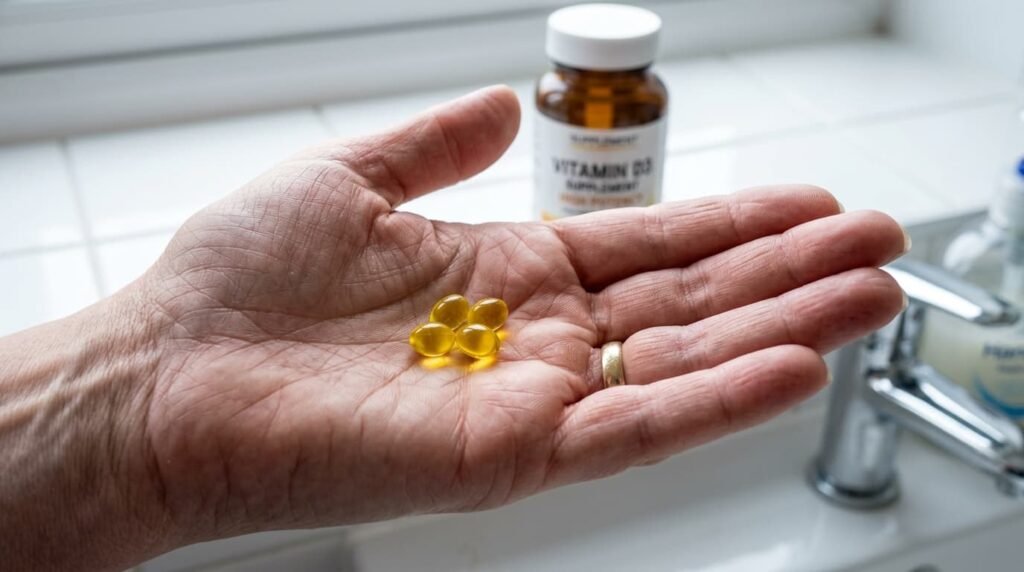
Vitamin D3 versus D2
Vitamin D3 (cholecalciferol) is generally preferred over D2 (ergocalciferol) because it is more effective at raising and sustaining blood levels. Most quality supplements on the market use D3.
Combination formulas worth considering
Some evidence supports pairing vitamin D3 with vitamin K2, as K2 helps direct calcium into bones rather than soft tissues. Adding omega-3 fatty acidsinternal may also complement the anti-inflammatory benefits — particularly for those managing arthritis-related discomfort.
What to check on the label
- Dosage per capsule in IU or mcg (1 mcg = 40 IU)
- Third-party testing certification such as NSF or USP
- Oil-based softgels — vitamin D is fat-soluble and absorbs better this way
- Free from fillers if you have known sensitivities
Vitamin D Foods for Joint Health
Supplements are not the only route. A range of everyday foods can contribute meaningfully to your levels — no prescription needed.
Top food sources of vitamin D
- Oily fish — salmon, mackerel, sardines, and herring are among the richest natural sources
- Egg yolks — modest amounts, but a useful addition to a regular diet
- Fortified foods — breakfast cereals, plant-based milks, and certain spreads are commonly fortified
- Red meat and liver — contain small amounts alongside other joint-supportive nutrients
- UV-exposed mushrooms — a practical plant-based source; check packaging for confirmation
Diet alone rarely corrects a deficiency — especially in autumn and winter. But combining good food choices with regular sunlight exposure and a daily supplement creates a solid, reliable approach.

How to Increase Vitamin D Levels Naturally
Sunlight remains the most efficient source. The body produces vitamin D through UVB exposure on bare skin — no glass, no sunscreen, no cloud cover in between.
Practical tips for raising your levels
- Aim for 10–30 minutes of midday sun on arms and legs, several times per week (varies by skin tone and location)
- In the UK, this works reliably from April to September — after that, the UVB angle is too low
- From October to March, a daily supplement fills the gap
- Eat oily fish at least twice a week as part of a broader Mediterranean-style dietinternal
- Maintain a healthy weight — body fat sequesters vitamin D and reduces its How Long Does It Take for Vitamin D to Help Joint Pain?
- availability in the bloodstream
This is one of the most common questions — and the honest answer is: it depends on how low your levels are and how consistently you supplement.
When pain is primarily driven by deficiency, many people report noticeable improvement within 4–8 weeks of starting supplementation at a suitable dose. Full restoration of bone and muscle function can take three to six months, particularly if levels were very low to begin with.
Consistency is everything. Sporadic use will not produce the same result as taking a supplement daily. A follow-up blood test at the 3-month mark helps confirm whether your levels have reached the optimal range.
Frequently asked questions
Can low vitamin D cause joint pain and muscle pain at the same time?
Yes. Vitamin D receptors exist in both muscle and joint tissue. When levels drop significantly, aching across multiple areas — joints, muscles, and bones simultaneously — is common. It is one of the most frequently reported symptoms of deficiency in adults of all ages.
What vitamin deficiency causes joint pain most commonly?
Vitamin D is the most widely studied and confirmed cause. That said, deficiencies in vitamin C (which supports cartilage production), vitamin K (linked to bone density), and low omega-3 intake can also contribute to joint discomfort. A broad nutrient panel helps identify the specific gap.
How much vitamin D should I take for joint pain?
It depends on your starting blood levels. Most adults benefit from 1,000–2,000 IU of vitamin D3 daily for maintenance. For a confirmed deficiency, a doctor may recommend higher doses for a short period. Always test first — guessing dosage is not a great strategy.
Does vitamin D help with rheumatoid arthritis pain?
Evidence suggests correcting a deficiency can support better disease management in people with RA. Vitamin D helps regulate immune activity, which may reduce the severity of flares. It works best alongside — not instead of — prescribed treatments.
Can taking vitamin D reduce knee pain from osteoarthritis?
Research shows a clear link between low levels and greater knee pain in osteoarthritis, though supplementation trials show mixed results. Maintaining sufficient levels appears to support muscle strength and slow cartilage deterioration — which may ease pain over time, particularly in early-stage cases.
What are the signs of vitamin D deficiency in women over 50?
Joint stiffness, bone pain, fatigue, and low mood are the most common. These can be easily confused with perimenopausal symptoms. A vitamin D blood test is the clearest way to tell the difference. Women over 50 are at higher risk due to reduced skin synthesis and potential dietary shortfalls.
How long does recovery from vitamin D deficiency joint pain take?
Most people notice some improvement within 4–8 weeks of consistent daily supplementation. Full resolution — restored blood levels and cleared symptoms — typically takes 3–6 months. A follow-up blood test at 3 months confirms progress.
Can vitamin D deficiency specifically cause knee pain?
Yes. The knee is a major weight-bearing joint and particularly susceptible to the effects of reduced bone density and muscle weakness — both common consequences of low vitamin D. Knee aching is one of the more commonly reported joint-specific symptoms of deficiency.
Which foods are richest in vitamin D for joint health?
Oily fish such as salmon, sardines, and mackerel lead the list. Egg yolks, UV-exposed mushrooms, and fortified cereals or dairy alternatives also contribute. A balanced, Mediterranean-style diet provides the widest range of anti-inflammatory nutrients for joint support overall.

Low vitamin D and joint pain share a connection that is easy to overlook but simple to address once identified. If your joints have been aching without a clear cause, your levels may be worth checking — a basic blood test is all it takes to find out.
Correcting a deficiency does not require a complicated plan. Regular sunlight exposure, a diet that includes oily fish and fortified foods, and a daily vitamin D3 supplement cover most of what you need. For those managing conditions like osteoarthritis or rheumatoid arthritis, getting levels into the optimal range adds a meaningful layer of support alongside prescribed treatment.
Results take time — typically 4 to 8 weeks for early improvement and up to 6 months for full recovery. But consistency pays off. If joint discomfort has been slowing you down, this is one of the easier things to rule in or out. Start with the blood test.
Read more: Knee Arthritis Self Management Made Simple for Everyday Life
Read more: Bone on Bone Knee Treatment: Effective Solutions for Relief