Knee Brace for Osteoarthritis Find the Right Type for Lasting Pain Relief

Knee brace for osteoarthritis is among the most clinically supported non-pharmacological interventions available and consistently one of the most underused. Osteoarthritis affects over 8.5 million people in the UK, with the knee being the most commonly involved joint. Yet a significant proportion of patients spend years managing pain through medication alone, without ever being assessed for the mechanical support that could reduce that pain more directly and with fewer side effects.
The reason bracing works is straightforward. Knee osteoarthritis typically damages one compartment of the joint more than the other — usually the inner side. Every step taken places compressive force through that damaged area. A correctly fitted offloading brace redistributes that force, reducing the load on worn cartilage during weight-bearing activity. The joint does not change. The pain does.
What makes brace selection genuinely complex is that the wrong type or the wrong correction direction can worsen symptoms rather than improve them. The choice between a rigid frame, a knitted support, or an unloader design depends on which compartment is affected, how severe the damage is, and what the patient actually does day to day.
What a Knee Brace for Osteoarthritis Actually Does
Understanding how a knee brace works mechanically makes the difference between choosing one that genuinely helps and one that simply adds bulk under the trouser leg.
The Biomechanical Principle Behind Offloading
Osteoarthritis does not affect the entire knee joint equally. In most patients, the damage is concentrated in one compartment — either the medial (inner) side or the lateral (outer) side of the femorotibial joint. When that compartment bears load during walking, the cartilage-depleted surfaces press against each other, producing pain.
An offloading knee brace works by applying corrective forces across the joint to shift load away from the damaged compartment. This is not cushioning in the conventional sense — it is a mechanical redistribution of force. The brace applies a three-point pressure system that gently opens the affected side of the joint, reducing the compressive load on the damaged cartilage.
The result is less pain during movement, improved walking distance, and greater confidence in the joint — without altering the underlying condition or requiring medication.
Who Benefits Most From a Knee Brace
Offloading knee brace osteoarthritis candidacy is most appropriate for patients with symptomatic femorotibial osteoarthritis that is predominantly unicompartmental — meaning the damage is primarily on one side rather than evenly distributed across the whole joint.

Patients with:
- Medial compartment OA — the most common pattern, producing pain on the inner knee
- Lateral compartment OA — less common, producing pain on the outer side
- Mild to moderate joint space narrowing on imaging
- Pain provoked by walking, stair climbing, or prolonged standing
are the most likely to see meaningful benefit from appropriate knee support for osteoarthritis.
Patients with severe OA affecting multiple compartments, inflammatory arthritis, or previous knee replacement surgery are generally not suitable candidates.
Types of Knee Brace for Osteoarthritis
Not all knee braces work the same way. The right type depends on which compartment is affected, how active the patient is, and how much correction the joint requires.
Rigid Offloading Knee Braces
Rigid knee brace osteoarthritis designs consist of a metal or carbon fibre frame with hinges on each side of the knee and padding at the points of corrective force application. The frame allows precise adjustment of the valgus or varus correction angle — the degree of load shifting applied to the joint.
These braces are the most biomechanically effective option and are particularly appropriate for patients who are physically active, who work on their feet, or whose pain during higher-demand activities is significant. They are more visible under clothing and require a fitting appointment to set up correctly.
The best knee brace for osteoarthritis UK patients with active lifestyles will typically find in the rigid category, though the specific product and adjustment parameters should always be determined by a suitably qualified clinician.
Knitted and Semi-Rigid Knee Braces
Knitted knee brace osteoarthritis designs use flexible fabric construction with strategically positioned non-elastic straps to distribute corrective force across multiple points. They are lower profile, more comfortable for daily wear, and more suitable for patients with a more sedentary lifestyle or those who need a discreet solution under work clothing.
Semi-rigid versions add lightweight lateral stays for additional stability without the full structure of a rigid brace. Both formats apply the same offloading principle — they differ in the magnitude of correction achievable and the clinical contexts in which they are most appropriate.
Unloader Knee Brace — How It Differs
The unloader knee brace is a specific design category — most commonly associated with the Össur Unloader One — that uses a patented three-point leverage system to produce unicompartmental knee unloading during weight-bearing activity. It is one of the most clinically studied knee brace designs available, with a substantial evidence base supporting its effectiveness for pain reduction and functional improvement.
For patients with knee brace for bone on bone presentations — where joint space is severely narrowed on imaging — the unloader design offers mechanical relief that analgesic medication cannot provide through the same mechanism.
Medial vs Lateral Osteoarthritis — Does the Side Matter for Brace Selection?
A medial knee osteoarthritis brace applies valgus correction, gently pushing the knee outward to shift load away from the inner compartment. A knee brace lateral osteoarthritis applies varus correction, pushing inward to unload the outer compartment.
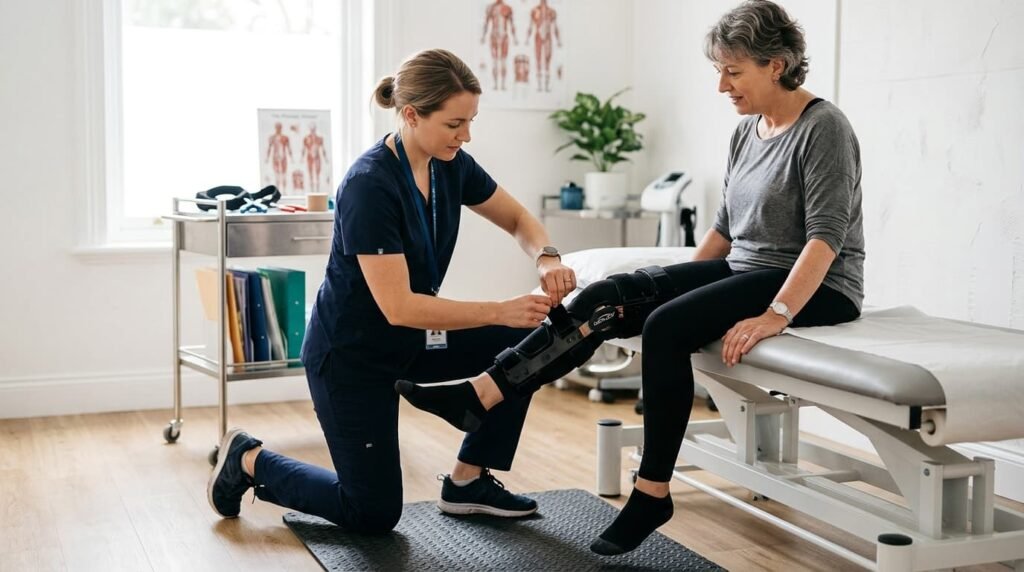
Applying the wrong correction direction does not simply fail to help — it can actively worsen symptoms by increasing load on the already damaged compartment. This is why professional assessment before brace selection is non-negotiable.
A unicompartmental knee osteoarthritis brace — whether medial or lateral — should be selected and fitted by a physiotherapist, orthotist, or musculoskeletal clinician with access to the patient’s imaging. The compartment involved, the degree of deformity, and the patient’s activity level all inform which design and correction angle is most appropriate.
Knee Brace for Osteoarthritis on the NHS — What to Expect
A knee brace for osteoarthritis NHS referral typically begins with a GP appointment, followed by physiotherapy assessment. A knee brace on the NHS is available for patients who meet the clinical criteria — primarily those with unicompartmental femorotibial OA who have not had surgical treatment.
NICE guidelines knee osteoarthritis recommend non-pharmacological interventions — including bracing, exercise, and weight management — as first-line treatment before progressing to pharmacological or surgical options. Bracing is specifically recommended within this framework when clinically indicated.
NHS provision of the unloader one knee brace is available through AXA and directly via physiotherapy referral in many areas. Patients can also ask their GP or physiotherapist specifically about unloader brace eligibility.
Waiting times vary by region. For patients whose pain is significantly limiting daily function, private assessment provides faster access to fitting and follow-up adjustment.
Non-Surgical Knee Osteoarthritis Treatment — Where Bracing Fits In
Bracing is one component of a broader non surgical knee osteoarthritis treatment pathway. Used in isolation, it provides mechanical pain relief during activity. Used alongside other interventions, it enables patients to exercise more effectively, engage more productively with physiotherapy, and reduce their reliance on analgesic medication.
Physiotherapy for Knee Osteoarthritis UK
Physiotherapy for knee osteoarthritis UK is the most evidence-supported first-line intervention available. A structured programme of quadriceps and gluteal strengthening reduces the muscular load passing through the joint during daily movement — complementing the mechanical unloading that a brace provides during activity.

Knee osteoarthritis exercises UK delivered by a physiotherapist are more effective than generic exercise advice precisely because they are adjusted to the individual’s strength, range of motion, and pain response. For those interested in cycling as part of their rehabilitation, the research on cycling for knee OA is reviewed in detail separately.
Hot and Cold Therapy for Knee Pain
Hot and cold therapy for knee pain provides symptomatic relief without addressing the underlying joint condition. Ice reduces acute inflammation and swelling — most useful after activity or during a flare. Heat relaxes the surrounding musculature and improves circulation — more useful for morning stiffness before activity.
Both are appropriate as adjuncts to bracing and exercise, rather than primary treatments.
Knee Injection for Osteoarthritis UK
Knee injection for osteoarthritis UK options include corticosteroid, hyaluronic acid, and Arthrosamid. Injections reduce joint inflammation sufficiently to allow more effective exercise and physiotherapy — they do not repair cartilage or replace the mechanical support that a brace provides.
For patients whose pain level prevents effective use of bracing or physiotherapy, injection therapy may be the appropriate first step before bracing and rehabilitation begin. Specialist assessment determines the correct sequence.
Alternatives to Knee Replacement UK
For patients who have exhausted conservative management, alternatives to knee replacement UK include two main surgical options:
- Knee osteotomy UK — surgical realignment of the tibia or femur to shift load off the damaged compartment. Suitable for younger, more active patients with unicompartmental disease.
- Unicompartmental knee replacement — resurfaces only the affected side of the joint. Faster recovery than total replacement and preserves more natural bone.
Total knee replacement recovery in the UK typically takes three to six months. Unicompartmental procedures are generally quicker. Both carry specific eligibility criteria and should be discussed with an orthopaedic consultant.
Total knee replacement alternatives — including injection therapy, bracing, and structured rehabilitation — should always be fully explored first. NICE guidelines knee osteoarthritis explicitly support this sequencing.
Alongside bracing and surgery considerations, femorotibial osteoarthritis treatment in the non-surgical pathway includes weight management. A ten percent reduction in body weight produces measurable reductions in knee pain — compounding the benefit of both bracing and exercise.
Non pharmacological knee pain treatment works best as a combined approach. Brace, physiotherapy, weight management, and injection therapy together consistently outperform any single intervention used alone.
For patients also managing type 2 diabetes or other metabolic conditions, knee pain relief without medication carries additional value. Anti-inflammatory medications interact with metabolic health in ways that make mechanical options — bracing and appropriate injection therapy — a more straightforward clinical choice.
FAQ
What is the best knee brace for osteoarthritis in the UK?
The best knee brace for osteoarthritis UK patients depends on the compartment affected, activity level, and severity of OA. The unloader one knee brace is the most clinically studied option and suits a wide range of patients. Rigid designs suit more active patients. Knitted knee brace osteoarthritis formats are preferable for everyday low-impact use. A physiotherapist or orthotist should confirm the most appropriate design following clinical assessment.
Can a knee brace for osteoarthritis be obtained on the NHS?
Yes. A knee brace for osteoarthritis NHS referral begins with a GP appointment and physiotherapy assessment. NICE guidelines knee osteoarthritis support non-pharmacological interventions as first-line treatment. The unloader one knee brace is specifically available on the NHS in eligible patients and through AXA private health insurance.
What is an offloading knee brace and how does it work?
An offloading knee brace applies a three-point corrective force to shift load away from the damaged compartment of the knee joint. This reduces the compressive force on worn cartilage during weight-bearing activity, lowering pain without medication. It is the primary mechanism behind all knee brace for osteoarthritis designs.
Is a knee brace suitable for bone on bone osteoarthritis?
A knee brace for bone on bone presentations can provide meaningful mechanical relief even in advanced OA — particularly a unicompartmental knee unloading brace that targets the specific side of the joint affected. It does not repair cartilage but reduces the pain produced by bone surface contact during activity.
Does a medial knee osteoarthritis brace differ from a lateral one?
Yes — significantly. A medial knee osteoarthritis brace applies valgus correction to unload the inner compartment. A knee brace lateral osteoarthritis applies varus correction to unload the outer compartment. Applying the incorrect correction worsens symptoms. Professional assessment is required to determine which type is appropriate.
When should a knee injection be considered alongside a brace?
A knee injection for osteoarthritis UK is appropriate when joint inflammation is too significant for bracing and physiotherapy alone to produce adequate relief. Injection therapy reduces the inflammatory environment sufficiently to allow more effective engagement with bracing and rehabilitation. The sequence of interventions should be determined by a specialist assessment.
A knee brace for osteoarthritis is not a passive support — it is an active mechanical intervention that redistributes joint load, reduces pain during activity, and enables more effective engagement with physiotherapy and exercise. Used correctly, within the appropriate clinical context and with professional fitting, it is one of the most practically useful tools in non surgical knee osteoarthritis treatment.
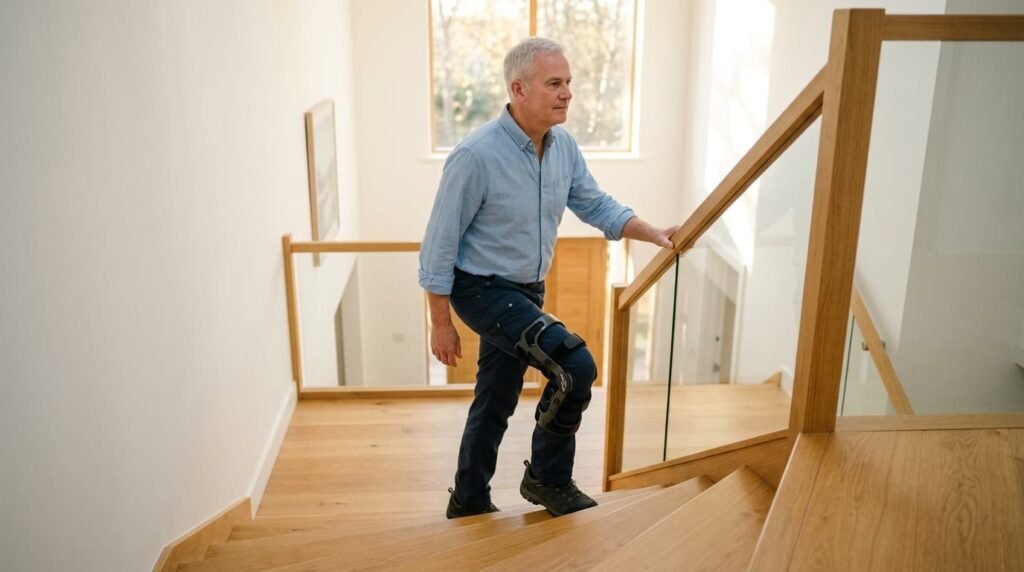
Choosing the right type — rigid, knitted, or unloader — depends on the compartment affected, activity level, and the degree of OA present. NHS access is available following physiotherapy assessment, and NICE guidelines knee osteoarthritis explicitly support bracing as part of first-line management.
Mr Syed Nadeem Abbas is a leading private knee expert based in London, specialising in non-surgical knee treatments including Arthrosamid injection for osteoarthritis. With over 3,500 patients treated across the UK, his practice focuses on delivering lasting knee pain relief without surgery.
Read more: Knee Pain After Steroid Injection Why It Returns and What to Do Next
Read more: Everything You Need to Know About Knee Osteoarthritis Pain