Golf and Knee Health Facts: Every Golfer Should Know Before the Next Round

✅ Medically reviewed | Updated september 2026
Golf and knee health depend on how golfers play, not just how often. A typical round means miles of walking, dozens of swings, and uneven ground. The knee absorbs all of it.
Versus Arthritis estimates that around 8.75 million UK adults aged 45 and over have sought treatment for osteoarthritis. The knee is among the most commonly affected joints. Many of those adults still want to play golf, and most can.
Golf sits in a helpful middle ground. It is gentler than running or football. However, it still asks the knee to rotate under load thousands of times each season. As a result, preparation decides whether a round helps the joint or irritates it.
Golf knee pain follows recognisable patterns. Spotting those patterns makes prevention far simpler. Small changes to setup, strength, and equipment often keep players on the course for decades.
Is Golf Good for Your Knees? The Benefits Behind the Round
The short answer is yes for most golfers. Golf offers steady movement without the pounding of running or jumping. Balanced golf and knee health build over a season, one round at a time.
Gentle Movement Keeps the Joint Lubricated
The knee is a synovial joint, so it contains a small amount of lubricating fluid. Bending and straightening the knee circulates that fluid around the cartilage. Golf delivers this movement in a controlled, low-impact way. A relaxed walk between shots suits stiff joints far better than a long spell on the sofa.
Walking 18 Holes Steps Up Daily Activity
Walking 18 holes steps past the 10,000 mark on many courses, depending on the layout. That total matches common daily activity targets. Hilly courses raise the effort further. They also raise the load on the knee, so pace matters.
How Golf Compares with High-Impact Sports
Running sends repeated impact through the knee with every stride. Court sports add sudden stops and hard pivots. Golf avoids most of that. The trade-off is repeated rotation instead of repeated impact.
For many people with stiff or sore joints, that trade-off suits better. Golf and knee health therefore compare well with most high-impact options, provided the swing load stays under control.
Stronger Muscles and a Lighter Load
The golf swing starts at the ground. Glutes, hamstrings, and quadriceps steady the knee through impact. Regular rounds keep those muscles working.
Body weight matters too. Each extra kilogram adds several kilograms of force through the knee with every step. Steady walking helps with weight control and eases that load. Strong muscles act as natural shock absorbers for the joint. Fresh air and good company also help. Lower stress often makes chronic pain easier to manage.
Is Golf Bad for Your Knees? Where the Risks Sit

Golf is not risk-free. The swing twists the knee under load thousands of times a season. Small faults repeat, and repeated faults add up.
Which Knee Is Most at Risk in Golf?
The lead knee carries the greatest load. That is the front knee, closest to the target. For a right-handed golfer, it is the left knee.
During the downswing, the lead knee rotates quickly while staying fairly straight. Research on the lead knee golf swing links this pattern with extra stress on the inner joint surfaces. Those surfaces are the areas most affected in knee osteoarthritis.
Golf Swing Knee Stress and the Twisting Problem
Golf swing knee stress comes mainly from rotation. The foot stays planted while the body turns. The knee sits in the middle and absorbs the mismatch.
Stiff hips make it worse. A limited hip turn forces the knee to rotate more. Stiff ankles add to the problem.
Golf Stance Knee Pain Starts Before the Swing
Golf stance knee pain often begins before the club moves. A very wide stance increases sideways load on the inner knee. Locked knees at address remove natural shock absorption. Poor foot position adds twisting force.
A 2022 biomechanics study in Scientific Reports examined lead knee loading. A narrower stance and a fuller weight shift lowered a loading measure linked to inner knee arthritis. Small set-up changes can shift the load more than dramatic swing rebuilds.
Some research suggests that roughly one in three golfers with earlier knee pain feel that golf worsens it. Existing knee problems deserve extra care.
What Causes Golf Knee Pain?
Golf knee pain rarely has a single cause. Several factors usually overlap. Spotting them early makes correction easier.

- Repeated rotation: The lead knee twists thousands of times each season.
- Existing joint wear: Osteoarthritis or an old ligament injury reacts to twisting loads.
- Set-up errors: Stance width, foot angle, and weight transfer all change the load.
- Stiff hips or ankles: The knee compensates for movement lost elsewhere.
- Tired support muscles: Weak glutes and quadriceps leave the joint exposed late in a round.
- Heavy bags: A full bag adds force through the knees, hips, and back.
Twisting loads can also irritate the meniscus, the knee’s shock-absorbing pad. Repeated strain there often produces catching or a dull ache along the joint line. Knee pain from golf usually builds slowly. Golf-related knee pain often appears on the back nine, when muscles tire. Ignoring early twinges can turn a minor irritation into a long break from the course.
Golf and Knee Osteoarthritis: Playing with a Sore Joint
Osteoarthritis wears down the cartilage that cushions the knee. Stiffness, swelling, and aching often follow. Golf and knee health can still coexist here, with sensible changes.
Can I Play Golf with Knee Osteoarthritis?
Many people with knee osteoarthritis keep playing golf. Gentle activity often eases stiffness. The right plan depends on symptom severity, swelling, and past injuries.
A pain flare after each round signals a need to adjust, not to ignore. Golfers can cut the load by using a trolley, playing nine holes, and choosing suitable tees. A structured low-impact exercise programme also supports the joint.
Signs That Call for a Break
- Swelling that lasts more than a few days
- Locking, catching, or giving way
- Sharp pain during the swing
- Night pain or pain at rest
- Pain that limits ordinary walking
Seek urgent medical help for a hot, red, rapidly swelling knee. Fever or an inability to bear weight also needs same-day attention.
Knee Pain After Golf: What Is Normal and What Is Not
A little muscle ache after a long round is normal. Sharp pain, swelling, or lingering discomfort is different. Timing and pattern give the best clues.
Normal Post-Round Soreness
Knee pain after golf that fades within a day or two usually reflects muscle fatigue. Rest, fluids, and a gentle walk help. Short spells of ice suit sore, tired thighs.
Pain That Needs Attention
Pain on one side of the knee, repeated swelling, or clicking with catching deserves a check. Several conditions can cause these signs.
- Inflammation of the joint lining causes warmth and puffiness.
- Bursitis causes localised swelling, often at the front of the knee.
- Irritation of the iliotibial band causes outer knee pain.
- Knee pain without a clear injury can still signal early joint wear.
How to Prevent Golf Knee Pain
Prevention costs less than recovery. Four habits do most of the work: warming up, building strength, adjusting the set-up, and lightening the load. Good golf and knee health routines take minutes, not hours.
Golf Warm-Up for Knees: Five Minutes Before the First Tee
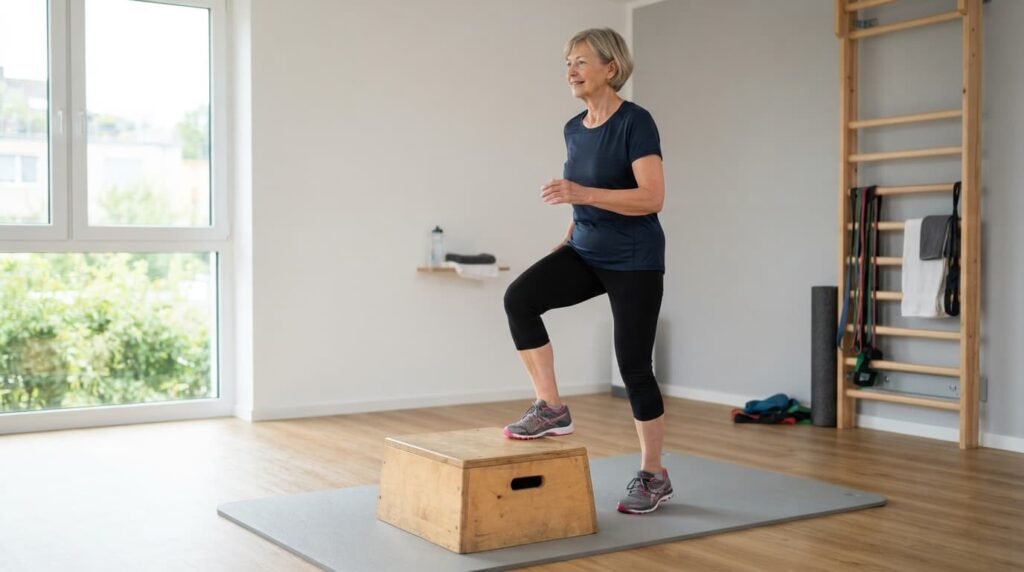
A cold knee sulks all around. A short golf warm-up for knees prepares the joint for rotation.
- Walk briskly for two minutes to raise the heart rate.
- Perform 10 bodyweight squats to wake up the quadriceps and glutes.
- Swing each leg forward and back 10 times to loosen the hips.
- Rotate the torso gently for 30 seconds each side.
- Finish with 10 heel raises for the calves and ankles.
Golf Knee Exercises for Strength and Control
Strength work between rounds protects the joint. Four simple moves cover the main muscle groups.
Glute Bridge
Lie on your back with knees bent. Lift the hips, pause, and lower slowly. Aim for two sets of 10.
Step-Up
Use a low, stable step. Drive through the heel of the lead leg. Aim for two sets of eight per side.
Wall Sit
Slide down a wall into a shallow squat. Hold for 20 to 30 seconds. Repeat three times.
Plank
Hold a straight line from head to heels for 20 to 30 seconds. Repeat three times.
Short exercises for golfers’ knees fit into ten minutes, two or three times a week. Consistency beats intensity every time. Stop any movement that provokes sharp pain.
Set-Up Changes for the Lead Knee
Lead knee pain golf set-up changes are the simplest place to start. Open the lead foot outward by roughly 30 degrees at address. Research links this position with lower stress on the inner knee. A slightly narrower stance can help too. Pair these tweaks with a smooth weight shift. Avoid dramatic swing rebuilds without professional guidance.
Golf Trolley for Bad Knees Saves Energy
A golf trolley for bad knees removes the weight of a full bag from the walk. Pull trolleys suit flat courses. Electric models help on hills. A lighter load leaves the knees, hips, and back fresher for the closing holes. A buggy on a demanding course is a fair choice during a flare-up.
Build Up Gradually Each Season
A winter break shrinks strength and stamina. Jumping straight back into full rounds shocks the knee. Start with nine holes. Limit range sessions to a small bucket of balls. Add holes and swings across several weeks.
Muscles adapt faster than cartilage, so patience pays. Slow progress beats a forced rest.
Recovery After the Round
Recovery starts at the 18th green. Walk slowly for a few minutes instead of sitting down at once. Stretch the quadriceps, hamstrings, and calves gently. Drink water and eat a balanced meal.
Apply ice for 10 to 15 minutes if the knee feels warm or sore. Space heavy rounds apart while the joint stays irritable.
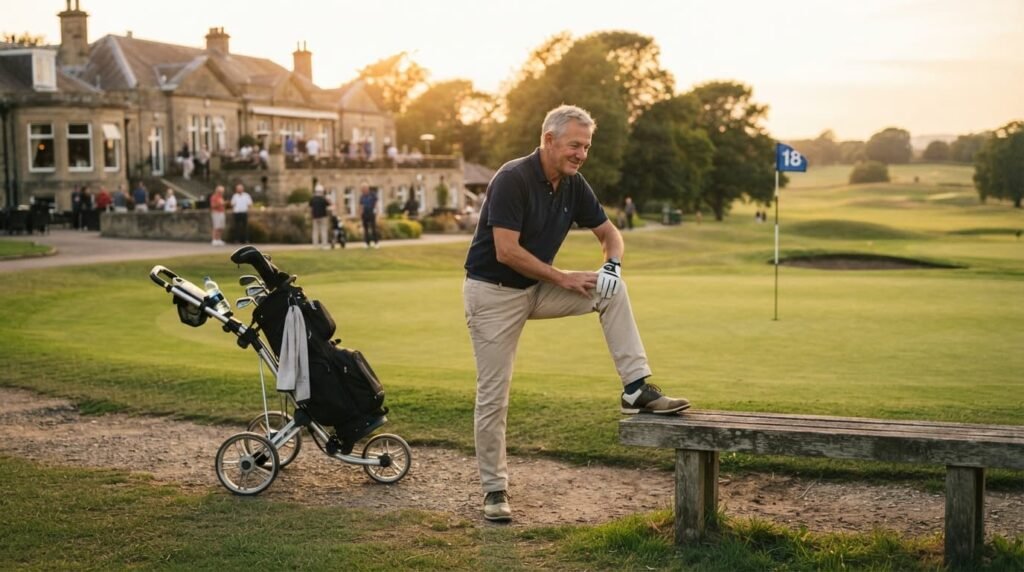
Footwear and Course Habits
- Choose golf shoes with cushioning and reliable grip.
- Replace worn spikes before they cause slips.
- Bend from the hips or use a ball retriever instead of dropping into a deep squat.
- Pace the walk on hills.
- Drink water through the round.
When Golf Knee Pain Needs Professional Help
Some pain does not settle with rest and strength work. Early assessment stops small problems from becoming long-term ones. Two routes usually help: physiotherapy and specialist review.
Golf Knee Pain Physio Support
A golf knee pain physio starts with a full assessment. The physiotherapist checks hip mobility, muscle strength, and swing-related loading. A programme of strengthening and mobility work usually follows. Golf coaches can then refine the set-up.
Specialist Review and Non-Surgical Options
Persistent pain, repeated swelling, or an old injury calls for specialist review. Imaging and a clear diagnosis remove the guesswork. Many golfers feel reassured when a knee surgeon, or any expert who understands the swing, explains the options.
Where tests confirm osteoarthritis, non-surgical treatments exist. A hydrogel injection is one option considered for suitable patients. It does not reverse joint damage, and results vary. Reading how clinics report Arthrosamid success rates helps set realistic expectations. Patients weighing pathways can also read about private knee pain treatment in London.
Video explanations of knee conditions are also available on the Dr SNA Clinic YouTube channel.
Frequently Asked Questions
Is golf good for your knees after 60?
Often, yes. Low-impact walking and controlled rotation suit many older golfers. Strength work, a warm-up, and a trolley improve comfort. Anyone with known joint disease should agree on a plan with a clinician first.
How can golfers prevent knee pain from golf?
Warm up before every round. Build glute and quadriceps strength twice a week. Open the lead foot slightly at address. Use a trolley and treat swelling early.
Does a golf trolley for bad knees really help?
It removes the weight of a full bag, which lowers the load on the knees, hips, and back. The walking benefit stays intact.
Should golfers see a physio or a specialist first?
A golf knee pain physio suits gradual, activity-related pain. Swelling, locking, a past injury, or pain that persists calls for specialist review.
What protects golf and knee health over the long term?
Consistency matters most. Strength work twice a week, a warm-up before each round, a sensible set-up, and weight control all help. Early assessment of persistent pain protects the joint further.
How long should knee pain after golf last?
Muscle soreness fades within a day or two. Pain or swelling beyond a few days needs assessment.
Golf and knee health work well together when golfers play with care. Regular walking, strong muscles, a sensible set-up, and a trolley all protect the joint. Early attention to warning signs keeps golfers on the course.
For a clear diagnosis of persistent knee pain linked to golf, kneepainclinicuk.com offers private knee assessment. Mr Syed Nadeem Abbas brings more than 20 years of experience with complex knee conditions. His approach focuses on joint preservation and, where suitable, non-surgical options. Book a consultation to discuss persistent knee pain and the most suitable next step.
Read more: Top Mistakes After Knee Replacement Often Go Unnoticed Until Too Late
Read more: Knee Aspiration Removes Fluid to Ease a Swollen and Painful Knee